Making Decisions in Safety: We Are Not as Rational as We Think
Test your Maths. Do not try to solve this problem, just listen to your intuition: A ball and a bat cost $1.10 altogether. The bat costs $1.00 more than the ball. How much does the ball cost?
If your answer is 10 cents, you’ve got the wrong answer. The feature of this easy question is that it evokes an answer that is both intuitive and wrong. If you sit down and do the Maths, you will find that the correct answer is 5 cents.
Daniel Kahneman, a Nobel Laureate and Professor of Psychology at Princeton, has asked this question to thousands of university students. More than 50% of students at Harvard, MIT and Princeton give the incorrect answer. (So, please do not feel bad for getting it wrong!)
The Maths question demonstrates that we are not as rational as we think we are. Contrary to what economists, philosophers and social scientists have believed for centuries, Professor Kahneman discovered that we are more biased than we like to believe.
It is just the way the human brain has evolved over millions of years. As it takes enormous energy to consciously work through different possibilities, we use unconscious shortcuts to cope with complexity. These shortcuts (or gut feelings, or common sense) speed up the decision-making process, and they work well in many cases.
For example, in the shopping centre, when we see a fuming mother with her 5-year-old child trailing behind, crying loudly, we can make sense of the situation in split seconds. We would probably guess the child must have done something that angered her mother. It could be the child pestering the mother for yet another toy, or running wildly about with no regard for safety. In another example, when we notice an especially long queue in front of a certain food stall in the market, we immediately come to the conclusion that the food there must be delicious. Or when we are driving along the expressway during non-peak hours and there is a massive jam, we will judge that there has been a car accident.
While these mental shortcuts are useful in many cases, we are equally likely to be making the wrong decisions. (Think about the quick but wrong answer to the Maths question earlier.) These wrong decisions which the human mind makes in a predictable and systematic way are known as cognitive biases.
Cognitive bias can cause people to underestimate risk and overestimate the robustness of the safety system. Below are some types of cognitive bias common in the workplace safety context.
Overconfidence bias: Over-estimating one’s abilities and knowledge. For example, a factory operator may refuse to put on eye protection when operating a machine because he has been doing the work for years without an accident.
Confirmation bias: The tendency to interpret and remember information in a way that confirms one’s preconceptions. For example, a maintenance manager who wants to cut costs, would tend to believe that using cheaper equipment would not compromise equipment integrity. He would favour comments that equipment maintenance can be delayed for a few more months, over those pointing out that maintenance must be carried out as soon as possible.
Attribution bias: The tendency to believe that one’s own success is due to ability rather than to surrounding factors; while the success of others is due to their surrounding factors rather than their personal ability. For example, when we see a young chap driving a Ferrari, we tend to conclude that he has a rich father (surrounding factor) rather than that he is extremely capable (personal factors). When a worker suffers an injury, attribution bias can cause the safety manager or operation manager to jump to the conclusion that that the worker is careless (personal factors), rather than there being flaws in the safety management system (surrounding factors).
Status quo bias: The tendency to prefer things to stay the same. The human mind prefers the familiarity of the current conditions over the uncertainties of the future. For example, even though a string of accidents points to the need to put more effort and resources into workplace safety, status quo bias can cause the management to continue to “live” with the existing system.
Outcome bias: The tendency to judge a decision by its eventual outcome instead of based on the quality of the decision at the time it was made. For example, a few months after implementing a safety improvement plan in a factory, two accidents occur. Outcome bias can cause the management to judge that the improvement plan was not effective and demand that the plan be overhauled, rather than looking at the quality of the plan and giving continued support.
Recency effect: The tendency to over-focus on things that happened the most recently. For example, a manufacturing company which used to have many accidents has had none for the last three months. As a result of the recency effect, management believes that all is well, and starts to put less effort into workplace safety.
Sunk cost effect: The tendency to continue investing in something that clearly isn’t working. For example, in one company, after investing a significant sum into purchasing software for accident statistics and tracking, initial feedback from the ground is that the software is cumbersome and non-intuitive. Even after using the software for a year, significant problems still exist. Because of sunk cost effect, the safety head decides to continue to use the software, instead of replacing it with different software.
How do we prevent cognitive bias?
Cognitive biases are unconscious and hard-wired into our thinking. As such we cannot deactivate our biases, even though we are aware of them. To give an analogy, being aware that we are short-sighted does not deactivate the symptoms. However, we can counteract cognitive biases with the right discipline.
Alfred Sloan, long-time CEO of General Motors, is reported to have interrupted a top committee meeting with a question. “Gentlemen, I take it we are all in complete agreement on the decision here?” Everyone nodded. “Then,” Sloan said, “I propose we postpone further discussion of this matter until our next meeting to give ourselves time to develop disagreement and perhaps gain some understanding of what this decision is about”. Sloan had developed the discipline to consider the opposite of his initial gut feeling. He was willing to spark constructive disagreement, and understand that disagreement.
Management guru Peter Drucker believes that disagreement protects a decision maker from being taken in by the plausible but false or incomplete. Unless we have considered alternatives, we have a closed mind. Therefore, in high-stake decisions especially, we owe ourselves a healthy dose of scepticism.
In his article on decision making, Drucker writes: “The effective decision maker does not start out with the assumption that one proposed course of action is right and that all others must be wrong. Nor does he start out with the assumption, I am right and he is wrong. He starts out with the commitment to find out why people disagree”.
Drucker points out that when an effective decision maker has a clear and obvious decision and someone disagrees with him, the dissenter should not be seen as a fool or a rogue. Rather, the dissenter should be assumed to be fairly intelligent unless proven otherwise. Therefore, that person must have seen a different reality and from a different angle. The effective person is first concerned with understanding the reasons behind the disagreement. Only then does he consider who is right and who is wrong. This understanding process often leads to better decisions.
In summary, we use mental shortcuts that help us cope with the complex world and make quick decisions. Though such shortcuts often work well, they can also lead to wrong decisions. This is known as cognitive bias. As cognitive biases are automatic and cannot be deactivated, discipline is required to counter them. One example is the discipline to spark constructive disagreement, and understand that disagreement.
However, countering cognitive biases does not happen in a vacuum. It goes hand-in-hand with creating a climate of trust and openness. Only then will there be an honest flow of information from different perspectives.
References
- Daniel Kahneman, Thinking, Fast and Slow, Farrar, Straus and Giroux; April 2, 2013
- Peter Drucker, The Essential Drucker: The Best of Sixty Years of Peter Drucker’s Essential Writings on Management, HarperBusiness; July 22, 2008
Unsafe Behaviours — Why employees are often NOT the problem
Businesses find that accidents still happen even after safety systems have been implemented. After conducting accident investigations, one issue stands out: most accidents are triggered by unsafe behaviours.
Since multiple studies have confirmed that “85% or more accidents are caused by unsafe behaviours,” the next step seems obvious: focus on the behaviours of employees. Commonly used approaches include training, briefing, policing, incentivizing safe workers, and disciplining unsafe ones.
The notion that unsafe behaviours directly contribute to accidents is correct, but it is also misleading. It can set up a manager to see employees’ behaviour as the standalone problem to be fixed, rather than a piece of a bigger puzzle. The fact is, behaviours don’t occur in a vacuum; they are driven by a network of factors such as safety systems, leadership, and culture. The evidence confirming this assertion is overwhelming:
• “a culture of widespread non-compliance with safety procedures” (Judge Chay, 2016) — Court judgement on SMRT employees killed by a train (2016)
• “safety system deficiencies created a workplace ripe for human error to occur” (CSB, 2007,) — Accident investigation of the BP Texas City Explosion (2005)
• “organizational or corporate level failures are the most critical ones that need attention if accidents are to be avoided” (Bowonder, 1986) — Accident investigation of the Bhopal Gas Leakages (1986)
There is a mismatch between what research (and accidents analysis) reveal, and what business does. Instead of focusing on system deficiencies or organizational failures that allow such behaviours to thrive, there is an over-emphasis on worker’s behaviour. Case in point: how often have you seen accident investigation reports concluding that the root cause is “employees not following procedures,” with the corrective action being to “re-train the employees”? How many times have you heard managers exclaiming, “Why can’t employees follow rules, and how can we change their mindset?”
Unsafe Acts at a Construction Company
Take the example of a construction company that had a two-storey temporary office. During lunch time, the project manager observed that a number of staff liked to run down the staircase. They didn’t hold hand rails and often hopped down two steps at a time. It was unsafe. To fix the behaviour, the manager sent out emails to remind his staff about staircase safety. He also assigned staff to paste precautions about trips and falls in the office.
But the situation did not improve. One day a staff member fell down the staircase and fractured his arm. It was then that someone in the management team asked the question, “Why are staff running down the staircase?” It turned out that the lunch area on the first floor had limited seats. The last few staff that arrived had to stand to have their lunch. As the management staff drove out for lunch, they were not aware of this issue. Once this situation was known, the solution was simple: staggered lunch times. Since the solution was implemented, staff no longer ran down the staircase during lunch hours, because they didn’t have to. When you change a system or culture, you change behaviours.
Looking at Behaviours in a Broader Context
In recent years there has been a gradual shift from focussing narrowly on employees’ behaviours to looking at behaviours in a broader context. In the United States, there have been an increasing number of articles and discussions geared towards Human and Organizational Performance (HOP). Based on the work of Sidney Dekker, James Reason and Todd Conklin, the core principles of HOP are:
• Human error is part of the human condition, and is inevitable (i.e., expecting a worker to be mindful all the time is impractical).
• Human behaviours are the outputs of organizational culture and systems (i.e., when you put unsafe employees in an environment with a positive safety culture and a robust safety system, they will learn to work safely).
• To change behaviour, fix the systems to make safe work easy, and/or change culture norms to make safe work socially compelling.
• To understand specifically what needs to change, involve the employees and ask for their input.
There is often a difference between “work as intended” and “work as actually done.” Employees frequently know why they do what they do. When an employee doesn’t perform work as intended, it is often due to the following:
◘ Perceptions — “From my experience, this is OK.”
◘ Mental lapses — “I have forgotten.”
◘ Abilities — “I am required to finish this within X hours. Following the procedure will take 2X hours.”
◘ Social Environment — “My colleagues will mock me if I do things this way.”
Don’t jump to conclusion that an employee has a poor safety mindset. When you respond sternly and follow-up with more procedures, more policing and more paper work in a bid to control the employees, you achieve only short-term compliance. But if you ask the right questions and are willing to learn, you will gain untapped knowledge, which already exists in your organization. This knowledge will allow you to solve problems at their root.
The HOP approach is not exactly new; some of its principles are drawn from traditional safety concepts. What HOP does is to act as a counter balance against the belief that employees’ behaviours are the problem. For too long, management has been obsessed with unsafe employees’ behaviours. In some workplaces this obsession has resulted in touchy relationships with employees. HOP brings the systems and culture component back into the equation. When management looks at employees’ behaviour in the larger context of organizational performance, rather than as an isolated problem, it changes how safety is managed in the workplace.
Next time you see an unsafe act, don’t approach the person as a judge and tell him what to do. Instead, be a curious participant. Ask yourself, “Why would a rational person do that? What am I missing?” Then ask the worker, “What makes you do the work this way? What do you need?”
When a worker feels understood and involved, you will not only obtain insights to forge long-lasting solutions to work safety issues; you will also gain his trust and commitment.
References
- Bowonder, An analysis of the Bhopal accident, Project Appraisal, 2:3, 157-168. 1987
- Chemical Safety Board (CSB), Investigation report: Refinery explosion and fire, 2007
- Krause & B. Kristen Leadership, 7 Insights into Safety Leadership, The Safety Leadership Institute, 2015
- Conklin, Pre-Accident Investigations: An Introduction to Organizational Safety, CRC Press; 1 edition, 2012
Why Employees Don’t Speak Up for Safety—The Importance of Psychological Safety
As the monthly safety committee meeting approaches its end, the General Manager, who is also the committee chairman, scans around the table and asks, “Any issues or suggestions to highlight?” A dead silence prevails. “All right, that’s the end of the meeting. Thank you, everyone.”
Rahul, the maintenance manager, leaves the meeting with a heavy heart. Recently, the GM initiated a “Trim & Lean” initiative which would cut his maintenance budget by 30%, among other cuts. The GM is optimistic that this project will cut unnecessary waste. Rahul disagrees with the initiative, as it would affect the integrity of the equipment, which could result in safety and quality issues. But he decides to keep quiet, because he does not want to appear negative and unsupportive.
Chin, the operation technician, has a suggestion to highlight. Together with another colleague, he needs to access the rooftop of the server room to service a panel every week. Currently they use a fireman ladder for the work, which is quite heavy. If the panel could be relocated to the ground level, they could complete their task in a safer and more productive manner. But Chin isn’t sure how the GM will perceive this suggestion. What if the GM chides him for raising a silly idea? To avoid any potential embarrassment, Chin remains silent.
Have you ever had the same experience, feeling that you could not speak up at work? Such experiences are more commonplace than not. In a study investigating employee experiences with speaking up, 85% of respondents reported at least one occasion when they felt unable to raise a concern with their bosses, even though they believed the issue was important.1
The importance of speaking up
Speaking up is not just an activity that is nice to have; it is essential to prevent potential accidents. Numerous studies have revealed that a high rate of reporting incidents correlates strongly with lower fatality rates.2,3,4 Accidents seldom occur out of the blue. There are often signals that precede the accident; for example, faulty tools not being replaced, or employees ignoring procedure or simply box-ticking checklists. Capturing such signals allows these issues to be addressed before they escalate.
Consider the Deepwater Horizon oil rig explosion in 2011, which killed 11 workers and caused the world’s largest marine oil spill. After the accident, a survey found that many workers on the rig were concerned about safety in the weeks before the explosion.5 In the survey, they highlighted that the maintenance plan was not carried out properly and that they “often saw unsafe behaviours on the rig.” However, the workers did not report such problems to the management because they “feared reprisals”.
If you compare ISO 45001 with other management systems (e.g. ISO 9001, ISO 14001 and ISO 27001), you find that while all these systems require a communication process to be put in place, ISO 45001 is the only one which explicitly states the need for “workers’ participation.” It recognizes that the input of employees is mission-critical for a robust OHS system. In detecting safety risk, employees are the eyes and ears of the organization. Every time they withhold information, the organisation misses out on a chance to prevent a potential accident.
Conditions for employees to speak up
However, simply educating and reminding employees that they have a responsibility to speak up is NOT a good strategy. Knowing and doing are two different things. Almost every employee knows they have to speak up when they see something unsafe; but how many times do they actually do it? For employees to speak up, two conditions must exist. Responsibility rests on the leaders of the organization to create these conditions:
1 Platforms to capture input
2 Presence of psychological safety
Examples of platforms to capture input include: meetings with employee participation, near-miss reporting schemes, and dialogue sessions. These platforms are standard features for organizations that implement an OHS management system. They are also mandated by law for certain types of workplaces. For example, the WSH Committees Regulations requires factories with more than 50 persons to have safety committee meetings; and the safety committee must comprise at least 50% employee representatives. Such platforms provide avenues for employees to provide their input. But having such platforms is not enough, as evident in the Deepwater Horizon accident. Psychological safety also needs to be present.
Psychological safety is a belief that one will not be punished or humiliated for speaking up with ideas, questions, concerns, or mistakes. In her book “The Fearless Organization”,6 Amy Edmonson explains that “In psychologically safe environments, people believe that if they make a mistake or ask for help, others will not react badly. Instead, candor is both allowed and expected. Psychological safety exists when people feel their workplace is an environment where they can speak up, offer ideas, and ask questions without fear of being punished or embarrassed.”
As social creatures, we care about how others view us. We want to look smart and competent in front of our colleagues and bosses. Nobody goes to work wanting to look otherwise. To maintain a good impression, we perform quick mental calculations of how others judge our behaviours. We do this both consciously and unconsciously. If the chances of looking bad are high, we enter self-protection mode. To avoid looking silly, we don’t give suggestions. To avoid being blamed, we don’t report mistakes. To avoid being labelled as a trouble-maker, we follow the majority.
When psychological safety is low, the first thing on people’s minds is not contribution, but self-protection. Self-protection always results in silence, because nobody will be blamed or criticized for keeping quiet. As the saying goes, “better safe than sorry.”
One problem with low psychological safety is that you cannot tell if someone is holding back. Silence from the employees may mean they have no further input; or it could also mean they have reservations about that new initiative, but decided to lay low. You can’t know what lies behind the silence. This can lead you to assume that all is well until an accident happens down the road.
How to create psychological safety
Alfred Sloan, the late CEO of General Motors, is one of the greatest managers of his time. He once interrupted a committee meeting with a question: “Gentlemen, I take it we are all in complete agreement on the decision here?”7 All the committee members nodded. “Then,” Sloan said, “I propose we postpone further discussion of this matter until our next meeting to give ourselves time to develop disagreement and perhaps gain some understanding of what this decision is about.”
Sloan was aware that making the right decision demands different perspectives and adequate disagreements. He put in place the process to encourage his people to speak their minds. In his meetings, raising opposing views was not only welcomed, but expected. Leaders can learn from Sloan by putting similar processes in place.
While implementing a process is crucial, the linchpin of establishing high psychological safety is for leaders to demonstrate humility. After all, who wants to raise ideas when the superior appears to think that he/she knows everything?
Humility is the recognition that one does not have all the answers, and that others have perspectives that are worth listening to. Sloan could have easily imposed his views on the committee members, but he demonstrated humility by postponing the meeting. Other behaviours that demonstrate humility are to:
◘ Acknowledge that a new plan has much room for improvement
◘ Share that you have your blind spots about safety risks
◘ Recognize that the technicians know the bolts and nuts of their work better than you do
◘ Admit that you may miss out on something when making a decision
◘ Apologize for an oversight
These behaviours are expressions of vulnerability. When we say such things, we acknowledge that we are imperfect humans, and we make the other person feel safe to switch from self-protection to contribution mode.
However, showing humility is difficult for many people, because the human mind is hardwired to be overconfident.8 We tend to overestimate our abilities and judgement. We want to be seen as decisive and knowledgeable, even in the absence of objective evidence. We are also susceptible to Fundamental Attribution Error—when mistakes happen, we tend to overemphasize the internal characteristics of the employee (e.g. he is careless and lazy) and underestimate the external situations (e.g. he lacks the right tool). This leads to knee-jerk blaming and a climate in which others don’t feel safe to speak up.
Building psychological safety takes time and effort, but is indispensable in the journey towards safety excellence. Establishing high psychological safety leads to a learning organization, which is the flowerbed for innovative solutions and swift detection of safety gaps.
References
1 Milliken, F., E. W. Morrison, & P. F. Hewlin. (2003). An Exploratory Study of Employee Silence: Issues that Employees Don’t Communicate Upward and Why. Journal of Management Studies. 40(6): 1453–1476.
2 Barnett, A., & A. Wang. (2000). Passenger mortality risk estimates provide perspectives about flight safety. Flight Safety Digest, 19(4): 1–12.
3 Saloniemi, A., & H. Oksanen. (1998). Accidents and fatal accidents—Some paradoxes. Safety Science, 29(1): 59–66.
4 Størkersen, K. V., S. Antonsen, & T. Kongsvik. (2016). One size fits all? Safety management regulation of ship accidents and personal injuries. Journal of Risk Research, 20(7): 1154–1172.
5 Kollewe, J. (2010 Jul 22). Deepwater Horizon workers ‘concerned about safety before explosion’. The Guardian. https://www.theguardian.com/business/2010/jul/22/deepwater-horizon-workers-concerned-safety
6 Edmondson, A. C. (2019). The Fearless Organization, 1st edition. Wiley Publishing.
7 Drucker, P. F. (2006). The Effective Executive: The Definitive Guide to Getting the Right Things Done. HarperBusiness.
8 Tali, S. (2012). The Optimism Bias: Why we’re wired to look on the bright side. Robinson Publishing.
How to Obtain Senior Management Commitment in Safety — Beyond a Business Case.
As safety professional, you already know why senior management need to buy in to workplace safety, and what they need to do to lead in creating a culture of safety. In fact, you can find a tremendous amount of information on the internet about the why and what.
But I find information is lacking about the “how”: how do you obtain commitment from management? Most of the suggestions centre on a business case, which involves using facts and figures to demonstrate that good safety means good business. This approach has its limitations.
The business case approach
When I was a practitioner, there was a time when I felt the senior leadership team could do more to promote safety. During a team meeting, I put up a PowerPoint presentation about the financial benefits of safety. I provided facts and figures to illustrate the direct and indirect costs of accidents, and to share how safety leads to better productivity. Nobody disputed the data. In fact, some of the managers nodded their heads. The senior-most leader concluded that safety is critical and that every senior manager has to lead by example. At the end of the meeting, I introduced the strategic plan for the next two years. At that time, I felt hopeful about the change in mindset and behaviour that was to come.
It did not. Two months later, things remained in the status quo. The weekly walkabout by the senior management team was postponed repeatedly because of “urgent meetings.” The budget for equipment enhancement, such as installation of handguards and enclosures, was postponed to the following year because of a “tough business environment.”
That’s when I realized that knowing and doing are two different issues. Making a business case involves the underlying assumption that once people understand that certain changes are necessary, they will be motivated to take action. Unfortunately, humans are not known to be logical. Case in point: We know that exercising is beneficial for our health, but how many of us do it on a regular basis? We know what types of personal goals matter to us, but how many of us who set New Year’s resolutions actually achieve them
Knowledge is necessary for change, but it is not the key driver. From my observation of senior managers who have become staunch safety proponents, they fall into three categories:
1 Experienced a life-changing event
2 Socialization in a pro-safety environment
3 Compassionate by nature
1 Experienced a life-changing event
Rick, who was in his fifties, was the operations director of an MNC. When I first heard him address his staff, I was amazed by his conviction and passion. It was not so much about the things he said, but his tone and body language. It was like he breathed safety! It became no surprise once Rick shared his story: he was a survivor of Piper Alpha! As you may know, Piper Alpha was an oil rig that was destroyed by an explosion in 1988. More than 150 crewmembers were killed. Rick was one of the 60+ survivors who jumped down from the burning platform! When you have been through such a dramatic event, your mindset about safety changes instantly.
2 Socialization in a pro-safety environment
In my last corporate role, I got to know Brad, who was the Regional GM for the Korea business unit. At that time the business unit had a high number of motor vehicle accidents. When Brad got onboard, he made several significant changes in safety:
◘ Instead of reporting to the HR director, he made the safety manager report to himself.
◘ He expanded the safety department from one person to four.
◘ He made safety the first agenda item during his senior leadership meetings, and made his managers accountable for achieving safety goals.
Over the next two years, the business unit recorded a 50% drop in accident rate. When I ask him how he became so engaged in safety, his answer was that he had learned from his former company, which had a strong safety culture. In his former company, the CEO led by example and integrated safety into business decisions—everything from procuring equipment and hiring contractors, to organizing D&D. The culture he was exposed to shaped his beliefs about safety, and taught him the right way to do work. It made him who he is.
3 Compassionate by nature
The third type of driver—and the most common—is human compassion. Compassionate leaders strive to improve safety simply because they care about their people and feel that it is the right thing to do. Such leaders become “enlightened” in safety easily, because ensuring every employee goes home safely everyday resonates with their personal values.
The three drivers above have one thing in common: they all relate to emotions! Drivers 1 and 3 are self-explanatory. Driver 2 is also an emotional driver. Brad did not change because of reading an email or attending a training. He changed because he saw the actions of his former bosses and colleagues, felt their commitment, and knew it was for real.
What studies show
Studies have revealed the role of emotions in driving change. In The Heart of Change, John Kotter and Dan Cohen report on a study which interviewed over 400 people across more than 130 companies. They hoped to understand how change happens in large organizations. Their key finding:
Changing behaviour is less a matter of giving people analysis to influence their thoughts than helping them to see a truth to influence their feelings. Both thinking and feeling are essential, and both are found in successful organizations, but the heart of change is in the emotions. Behaviour change happens in highly successful situations mostly by speaking to people’s feelings. This is true even in organizations that are very focused on analysis and quantitative measurement, even among people who think of themselves as smart in an MBA sense. In highly successful change efforts, people find ways to help others see the problems or solutions in ways that influence emotions, not just thought.
In a nutshell, the flow of see–feel–change is more powerful than that of analysis–think–change.
Using See-Feel-Change in safety
I heard this story about poor housekeeping from a safety manager who worked in the supply chain industry. At one time the housekeeping in the warehouse was terrible. Equipment was stacked to three levels high, posing toppling risks. Electrical cables ran freely across passageways, creating trip and fall risks. He highlighted the problems to the warehouse manager several times, but nothing got done. He escalated the issue to the managing director, who merely gave a half-hearted nudge to the warehouse manager to rectify the issue. Nothing moved. Sensing that his MD did not see the conditions as a serious problem, the safety manager arranged for a warehouse visit with the MD. After the walkabout, he asked his MD in an earnest tone, “If it were your son, would you want him to work in such an environment?” By the next day the issue was resolved.
The safety manager used the see–feel–change approach by using compelling and eye-catching situations to help his MD visualize the problems. Below are other examples of how the see–feel–change approach can be used to obtain management commitment in safety:
Analysis–think–change | See–feel–change |
Present statistics to illustrate that accident rate is increasing and more efforts are required. | Humanize the numbers. Ask an injured worker to share how the accident affected him physically and emotionally. |
Provide details of what world-class companies do in safety. | Arrange trips to companies that set a world-class example. |
Ask employees to share opinions about poor quality tools and equipment. | Bring rusty/broken/defective tools into the meeting room and pass them around. |
While the see-feel-change approach is more powerful than analysis-think-change, we use the latter much more frequently, competently, and comfortably than the former. There is a gap between what studies recommend and the current approach in use. Before changing the mindset of management, perhaps we can change the way we look at change.
References
- Heath, Chip, and Dan Heath. Switch: How to Change Things When Change Is Hard. New York: Random House, Inc., 2010.
- Kotter, John P., and Dan S. Cohen. The Heart of Change: Real-Life Stories of How People Change Their Organizations. Boston: Harvard Business Review Press, 2012.
Three Ways to Achieve Zero Accidents, but only One is Right
If you ask someone, “What is good safety performance?” I bet the answer will be “no accidents.”
One day I asked a factory technician how he contributes to safety in his workplace. He replied, “My company goal is zero accidents. Whatever I do, as long as I don’t have an accident, I contribute to safety.”
That technician was using the bench drill machine to process an iron block. There was a retractable shield, which he should have pulled into place after mounting the block to protect himself from potential flying debris. He did not do so. When I asked him why not, he said, “This task just takes a few seconds. Nothing will happen. I have done it many times already.” He has not had an accident (yet), but what he did was unsafe.
There are three ways to achieve a record of zero accidents:
◘ Easy way – under-reporting of accidents
◘ Unreliable way – relying on luck, i.e. watching safety happen rather than making it happen
◘ Reliable way – having good defenses
How you get to zero matters. The easy way leads you to an illusion, which is self-deceptive. The unreliable way does not give you staying power. Only the reliable way leads you to zero consistently and predictably. Safety is not simply the absence of accidents; it is the presence of defenses.
Defenses-as-Planned vs. Defenses-as-Exist
When we talk about defenses, it is essential to distinguish between defenses-as-planned (DAP) and defenses-as-exist (DAE). DAP is a plan or intention; DAE is what exists in reality. There is often a gap between the two.
A classic example is the Deepwater Horizon accident. The oil rig had eight layers of equipment, as well as procedural defenses against backflow of oil from the well. These layers were their “defense-as-planned.” The accident happened because their “defenses-as-exist” were so porous—like Swiss cheese—that not a single layer could block the hazard.
Ironically, a day before the accident, a group of BP senior executives boarded the rig to celebrate a safety milestone. Workers on the rig had gone seven years without a lost-time accident! This, again, shows that accident rate is not an accurate indication of safety performance. What really impacts your safety performance are not the defenses that you plan to have (or think you have), but the defenses that actually exist.
What are good defenses?
While good defenses must solid, they are usually not impervious—there will be holes (known as residual risks) even in good defenses. These holes exist because beyond a certain point, reducing their sizes requires a disproportionate amount of resources. As long as the residual risk is deemed “as low as reasonably practicable” (or ALARP), the defense is considered good.
Big holes in the defenses
When the holes in the DAE become unreasonably big, they weaken the defenses.
◘ Some holes are promptly detected through safety processes, such as supervision, inspection, audit, and near-miss reporting. The corrective and preventive actions taken will shrink the holes.
◘ Some holes are not detected. For example, employees may follow procedures but at a superficial level, such as ticking the boxes of safety checklists without actually carrying out the checks. Based on the paperwork the defenses existed… but in reality, not so. This provides an illusion that the defense is working.
◘ Some holes are accepted. When employees skip a safety step to save time and effort, and do not experience any accident, the short-cut can gradually become the norm. Known as normalization of deviance, the holes increase in size over time and are accepted.
One example of a normalization of deviance is answering the phone while driving. Because the driver is unlikely to have an accident (at least initially) when doing so, it becomes a habit. Even when such a habit developed, an accident isn’t imminent—it will only happen when all other defenses fail simultaneously, such as driving on an eventful day when the driver is tired, and it is raining and the traffic is heavy, and he answers a call as usual.
Closing the gap between DAP and DAE
Here are some ways to close the gap betwen DAP and DAE
Embedding Chronic Unease – Chronic unease is a healthy scepticism about what you see and do. It is about inquiry, probing deep, and not taking things for granted. Chronic unease prevents the holes from getting bigger, through employees who feel uneasy about deviating from procedures and who would raise concerns. This concept is easy to understand, but difficult to implement: you cannot just tell employees to report near-misses or non-compliance and expect 100% cooperation. Putting the onus on the employees because it is the “right thing to do” is not a reliable approach.
Before chronic unease comes a climate where people feel psychologically safe to speak up. Let’s say an employee notices a machine which is producing a rattling noise. He suspects that the machine might explode at any time, and raises his concerns to his manager. Would the manager listen to him or dismiss his concern? Let’s say his manager decides to stop work for a few days and calls in an expert for a diagnosis. If it turns out to be a false alarm, how would the manager respond? If he decides to blame the employee, he can forget about embedding any shreds of chronic unease. What prevails instead is a culture of silence.
Obtaining operational intelligence – The frontline employees who deliver products and services are privy to the most important safety and operational data the company has available. They can tell you why the gaps between DAP and DAE exist, why they do what they do, and what improvements can be made. In most instances, when employees don’t follow procedures, they have semi-sensible reasons. Instead of jumping to conclusions and trying to fix them, start listening to them and involving them more.
When it comes to involvement, employees know the difference between a symbolic effort and a meaningful one. A symbolic one is when the manager makes most of the decisions, asks for feedback occasionally, and expects to hear affirmation. A meaningful one happens when the manager sees the employees as key players, really listens to them to understand their perspective, and works with them to address their concerns.
Asking great questions
If you want to find the answers, start by asking the right questions. You only get answers to the questions you have asked. Besides asking “What is our accident rate?” management can ask:
◘ Do we have a sound DAP?
◘ Where are the gaps between our DAP and DAE? How do I know?
◘ What would our technicians say about our DAP and DAE?
◘ Is our culture supporting or hindering the process of translating DAP to DAE?
◘ What plans do we have to close these gaps in the next three months? The next year?
◘ What is needed from me?
When you shift your focus onto DAP and DAE, slowly but surely, the accident rate will sort itself out. When you achieve the goal in this way, not only will you know it has been achieved, but you will also know how to replicate the results year after year.
References
- United States Coast Guard. Deepwater Horizon Accident Investigation Report. 2010. pg. 32
- Conklin, Todd. Pre-Accident Investigations: An Introduction to Organizational Safety. Boca Raton: CRC Press, 2012.
- Edmondson, Amy C. The Fearless Organization: Creating Psychological Safety in the Workplace for Learning, Innovation, and Growth. Hoboken: Wiley, 2019.
- Mathis, Terry L., and Shawn M. Galloway. Steps to Safety Culture Excellence. Hoboken: Wiley, 2013.
Beware of the “Fitbit Shake Syndrome”
One evening after dinner, my wife took out her Fitbit fitness tracker, held it in one hand, and started shaking it.
“What are you doing?”
“Clocking my steps. I can get a free voucher if I do this every day for a week.”
It turns out that an insurance company started a fitness challenge that rewards its participants for walking and jogging. 10,000 steps a day can be redeemed for a $5 shopping voucher after a week. All the participant needs to do is to wear the Fitbit when he/she goes jogging and the number of steps will be tracked. It is a win-win situation—the company enhances its brand image while the participants get fitter.
The problem is that the Fitbit cannot tell if you are actually jogging, or shaking it, or attaching it to a fan. It simply counts to-and-fro movements as steps. My wife is not the only one shaking her Fitbit. I have noticed people doing it in public, and in different manners: some people shook it while talking on the phone, while some shook it while surfing the net with the other hand. Why sweat when it is easier to trick the Fitbit?
I call this the “Fitbit Shake Syndrome” (FSS). It means that to achieve a target, people have the tendency to choose the easier and quicker route, even when it deviates from the original intent. As the targets are reached (e.g. 10,000 steps), this syndrome creates an illusion for program organizers that the intent (e.g. healthier living) is achieved.
This happens in workplace safety as well. A few years ago, when I was organizing a safety contest, I budgeted for twenty $100 shopping vouchers as incentives. The participants received quiz forms whose answers could be found on posters and exhibits in the exhibition area. I reckoned that searching the exhibits for answers would be a fun way to enhance their awareness in safety. The contest was successful—over 90% participation rate. The management was happy, and so were the twenty winners. But I didn’t feel satisfied—I noticed many participants gathered around their colleagues and simply copied the answers. They were figuratively shaking their Fitbits. While the contest saw great participation, it failed in meeting its intent, which was to increase safety awareness.
Table 1: Other examples of FSS in safety
Activity | Typical target | Intent | FSS |
Achieve ‘0’ accidents | 0 accidents | Everyone works safely | · Under-reporting of accidents · Creative accounting when accidents occur |
Complete inspection checklist | 100% completion rate | Identify potential issues before accidents occur | · Ticking the box without carrying out the inspection |
Conduct training/briefing | >90% attendance rate | Trainers and supervisors impart knowledge to frontline workers | · Trainers spent little time to prepare the materials and simply gwent through the motions during training. |
Submit safety suggestions | 2 suggestions per employee per month | Gather workable suggestions to improve the workplace | · Mindless scribbling to meet the submission deadline |
Even though FSS strays from the program’s intent, it still achieves the associated targets. If safety programs are managed mainly by “whether the targets are achieved,” you may not get an accurate picture of the performance. What you get are watermelons: the performance indicators look green outside (i.e. targets are achieved) but are actually red inside (i.e. intent is not met). Watermelons provide a false sense of security. That’s when you get caught by surprise when a major accident strikes.
Here some ways to eliminate FSS at the workplace.
- Emphasize the “Why” and “How” rather than the “What”.
In this metrics-driven world, we tend to simplify activities into numbers and relentlessly drive people to meet the targets. We incentivise people when the targets are reached, and nag/remind/force them when they are trailing behind. In the single-minded pursuit of targets, the intent of the program fades off, and FSS flourishes.
The intent (the “why”) and the process (the “how”) are always more important than the target (the “what”). The central theme of the fitness challenge is not about recording 10,000 steps (the “what); it’s about jogging more (the “how) and keeping fit (the “why”).
Similarly, in safety, the central theme is not about registering zero accidents (the “what”). It’s about following procedures and helping one another (the “how”) so that everyone goes home safely every day (the “why”).
To reduce FSS, when communicating with employees, try putting more emphasis on the “why” and “how” and less on the “what”. Rally them towards a cause rather than a number. Equally important, practice reflection and periodically check that your programs are still serving their intent.
- Reduce target-based incentives.
Incentives drive FSS. The more significant the incentives (or dis-incentives), the more tempting it is to shake the Fitbit. To eliminate FSS, you could reduce the magnitude of
◘ Target-based incentives, i.e. “If we achieve zero accidents, everyone will receive a 20% bonus.”
◘ Target-based dis-incentives, i.e. “Anyone who fails to submit two safety suggestions every month will not receive his/her salary for that month.”
Try increasing behaviour-based incentives instead. Appreciate staff who complete checklists diligently or who gives an engaging safety briefing. These are behaviours that lead to a safer workplace. Such behaviour-based incentives are more time-consuming to administer, because you need to walk the ground and catch people doing the right things. But this is what leadership is about: visiting your people at the frontline and spending time with them.
- Don’t force programs down the throats of the employees.
Relying on force and authority to implement programs only gets you so far. You will have no problems in meeting the targets, but quite often, you won’t drive the right behaviour. As you know, frontline employees are very smart. If they don’t agree with a program, they have 101 ways to shake their Fitbits behind your back.
People need to buy in to these programs. You need to involve them and collaborate with them. This is not easy. It usually starts with seeing the employees in different light. If you see them as pawns to control, they will keep their mouths shut and wait for your instructions. When you see them as your key players in the safety arena, you will behave differently, and they will respond to you differently.
Using the approaches above usually takes longer to achieve the intended targets. But when you have achieved the targets this way, you can be sure that your people are figuratively jogging outdoors and not shaking their Fitbits. Instead of watermelons, you will get cucumbers, which are green outside AND inside.
McDonald’s Food Scandal – Three lessons about Safety
In July 2014, there was a major food scandal in China that involved McDonald’s and KFC. Their supplies came from Chinese company Shanghai Husi. Undercover footage shows workers at the plant relabeling expired meat as fresh and handling food with bare hands.
It appeared that the floor of the processing plant was strewn with rubbish and sewage, and meat was scooped off the floor and thrown into mixers. Rotting meat was mixed together with fresh meat and packaged for sale. Regulators immediately closed the factory, and ordered McDonald’s and KFC to remove these food items from their menus.
This scandal offers several good lessons on safety culture and management.
- Safety and profits go hand in hand
Husi was able to clinch major contracts with McDonald’s and KFC because of the stringent food standards it upheld. It was GMP- and HACCP-certified, both of which are food safety management systems. Before the scandal, it was seen as a player that abided by laws and regulations. It was even listed by the local government as a model company of food safety. In China, where consumer trust in food safety is very weak, Husi had a strong competitive advantage over its peers.
You must have heard the story of the goose that lays the golden eggs. The farmer, because of his greed, eventually kills the goose to get more eggs. In the end, he loses the goose and all future supplies of eggs. Quality and safety is like the goose while profit is like the eggs. Ill-treating the goose to squeeze out more eggs might work in the short term, but never in the long term. For Husi, the strategy to sacrifice food safety for profits backfired. When the scandal was uncovered, the company suffered a massive loss of reputation and income.
James Reason, a legend in safety management, argued that there should be a balance between safety protection and production.
Diagram 1 shows the delicate zone that companies must remain within if they are to stay in business profitably and safely. An over-emphasis on safety and neglecting production pushes the company into the bankruptcy zone while the converse would cause the company to end up in the catastrophe zone.
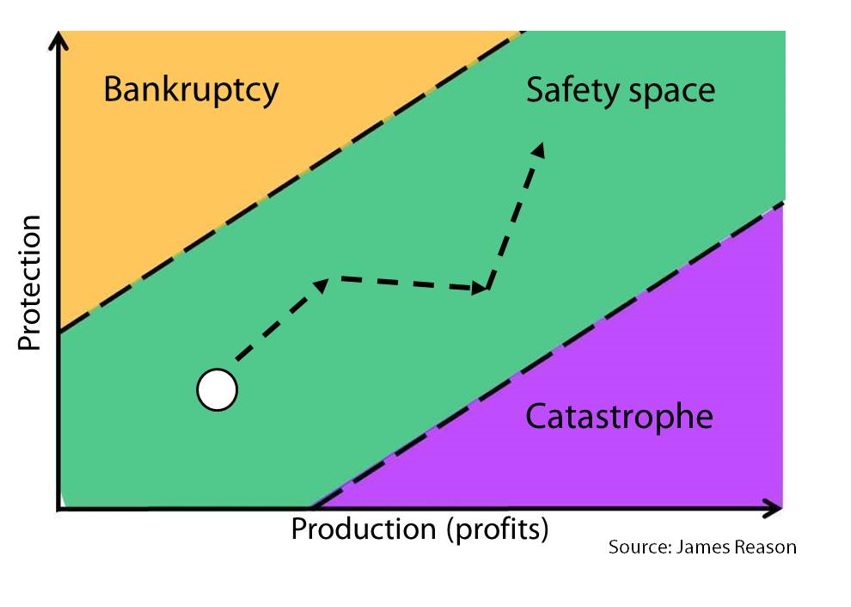
There is constant tension in the struggle between staying in business profitably and staying in business safely. One challenge is to prevent what we call “normalisation of deviance”, which is the tendency over time to accept anomalies —particularly risky ones— as normal. Think of the growing comfort a worker might feel with using a ladder with a broken rung: the more times he climbs the dangerous ladder without incident, the safer he feels it is.
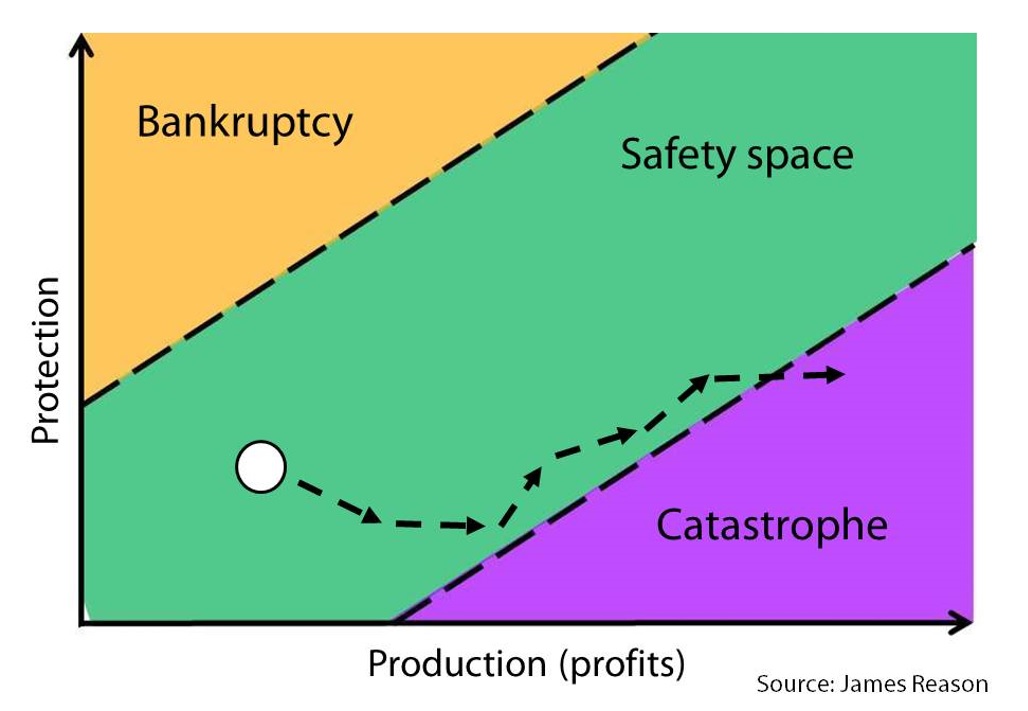
Normalisation of deviance has occurred when employees say, “We have done it this way before and there were no problems.” When employees cut corners in safety, the most likely outcome is that nothing will happen. As a result, the deviation is gradually accepted as the new norm. The safety state drifts towards the catastrophe zone and the margins for error become fewer (See diagram 2). When luck runs out, people get hurt.
Diagram 2: Normalisation of deviance
2. Culture eats systems for breakfast
Even though Husi had received GMP and HACCP certifications, the system was routinely bypassed because of shared assumptions about profits and food safety.
Table 1: In Husi: When the organisational culture clashes with the system requirements
System requirements | Culture assumptions | Actual Behaviours |
Food products that are on the floor cannot be used | Profit margin above all else People will not die from eating such products | The staff picked up food products on the floor and reused them |
Expired meat products cannot be used | Expiry date of meat products is extended so they can be used | |
Inferior products must be disposed of | Inferior meat products are deep-fried and mixed with raw meat, and then used for production | |
Production data must be recorded and documented | It is important to exercise creativity behind closed doors Outsiders must not know what we are doing | The factory keeps two sets of data: one for internal use, and another which is modified for external audit purposes |
Periodic audits are conducted by third parties to ensure conformance | The staff learnt of the audit a day in advance and made sure that only compliant products were being processed on the day |
When the organisational culture conflicts with the system requirements, culture will win every time. This is not to say that management systems aren’t important—they are critical in maintaining consistency and effectiveness of the process. However, management systems are not self-functioning. They depend on people to work well.
How honestly people adhere to procedures very much depends on organisational culture. While a management system tells people what they should do, culture tells people what to actually do. In the daily life of an organisation, individual staff have tens or hundreds of interactions with other colleagues. These interactions teach the individual the “right” way to see, feel and think with regard to the realities. Over time, this learning process creates a set of shared assumptions which form the essence of a culture.
For example, at a manufacturing site, a new technician who attended the safety induction learnt that “safety is our number one priority.” Two weeks later, the technician speaks to his manager about stopping a production line to rectify an unsafe condition. When his boss turns a blind eye, says he will think about it and does not follow up, the new hire learns something about stopping work. When he speaks to his co-workers about this and they tell him that “production is more important than safety here,” the technician gradually learns to see, feel and do the “right” thing in safety. The organisation’s culture is passed on to the newcomer. Such a socialisation process is so powerful that it can undermine even the most stringent protocol.
3. Everything rises and falls on leadership
The Xinhua News Agency quoted Shanghai’s food and drug watchdog on the fact that the food-safety violations at Husi were company-led. They were not the actions of individuals.
The top management in Husi:
◘ Asked the heads of departments to extend the expiry date of the meat products so that these products could be used.
◘ The day before an external audit was to take place, they sent emails to the staff asking them to shift the inferior meat products into the warehouse. This prevented the auditors from identifying the non-conformances at the production site.
◘ Assigned a team of staff to modify the out-of-range production data so that they would meet the production specifications. These “cooked” data were kept for external audit purposes.
In the video footage, a Husi worker who was reusing inferior meat said, “Management asked me to do this, so I’m just following instructions.” Another employee told the reporter that she had raised her concerns with her supervisor, but was advised that these were decisions made by the management. She was told to take care of her own tasks.
In her response to the British Petroleum Texas City explosion, Carolyn Merritt, Chairman of U.S. Chemical Safety Board, was quoted as saying:
“Safety culture is created at the top, and when it fails there, it fails workers far down the line. That is what happened at BP (Texas City).”
The above quote applies to Husi as well. When the top management of Husi send signals that profit-making is the top priority, they inadvertently create a culture that undermines food safety.
A safety culture starts with leadership. Leadership shapes culture, which in turn drives behaviour. The decisions leaders take to balance safety against commercial imperatives, the way they interact with the employees, and the incentives and measurement structures that leaders implement all directly impact the safety culture.
The food scandal shows the common tussles between safety, quality and production.
Is balancing between the goose and the eggs easy?
Definitely not!
But in this increasingly competitive marketplace, balancing both is what separates the winners from the rest.
References
1. Yum cuts ties to owner of China meat plant after scandal, Reuters, 23 July 2014 http://www.reuters.com/article/2014/07/23/us-china-food-idUSKBN0FS00120140723
2. Food safety – Not yum! The Economist Newspaper, Jul 23, 2014. Online version: http://www.economist.com/blogs/analects/2014/07/food-safety
3. Shanghai shuts factory supplying out-of-date meat to American fast food chains including McDonald’s and KFC, Daily Mail UK
http://www.dailymail.co.uk/news/article-2699623/McDonalds-KFC-China-face-new-food-scandal.html
4. Undercover video in Husi, SMG Official TV Channel http://goo.gl/oR3R9Z
5. Reason, James. Managing the Risks of Organizational Accidents. Ashgate Publishing Company, 1997
6. Covey, Stephen 7 Habits of Highly Effective People, DC Books 2005
Bureaucracy – The Problems with Too Many Safety Rules and Procedures
I was once in a client’s office and needed something in the pantry. After topping off my water bottle, I noticed an electric kettle at the end of the table top. It was placed within a square formed using four strips of yellow tape (the type that reminds me of a 5S workplace.) On the body of the kettle were the painted words, “Caution: May be hot.”
Unable to contain my curiosity, I asked the safety officer about that kettle. His reply was, “Somebody put the kettle in the middle of the table top after use. Another staff member who was using the table top got burnt when she tried to shove the kettle aside. It was not serious, but we take precautions. Safety is important to us.”
Indeed, the company’s commitment was evident in the little things, such as a ‘sharp edges’ warning on a paper tower dispenser, and ‘Put on lid if contents are hot’ reminders at the cup rack. (That was just in the pantry! There were many more around the factory). While I certainly admired the commitment of the company, I was sceptical about the output of that commitment. It was an overkill. A handful of such statements are helpful, but when there are too many of them, they get ignored, and become part of the background. The employees of the company most likely don’t paste such reminders at their homes, and yet they manage these risks well enough that they are able to come to work safely every day.
It is one thing to reduce the risk to “as low as reasonably practicable” and another to adopt a “worst first thinking”—thinking of the worst thing that could happen and acting as if it were likely to happen. What’s possible becomes probable, and risk management becomes risk averseness.
Procedures and rules are like the porridge in the story of Goldilocks and the Three Bears. There is a balance to strike: when you have too few procedures, certain risks will be overlooked; and when you have too many, the system becomes bureaucratic. “Bureaucratic” refers to procedures that are:
◘ Excessive, based on level of risk, and
◘ Complicated or lengthy, such that it is hard to get something done
Whether in safety or otherwise, it is much more common to find bureaucratic procedures than inadequate ones. For example, one study1 of railway workers in the Netherlands found that:
• 95% thought that work could not be finished on time if the rules were all followed
• 80% believed that the rules were mainly concerned with assigning blame
• 79% thought there were too many rules, while 12% thought there were too few
• 70% found the rules too complex and hard to read when they had found them
• Not one could remember ever having referred to the rules in a practical work situation in the last six months.
If employees do not see rules as enhancing their safety, or as not relevant to their jobs, they are less motivated to comply. This leads them to take the rules lightly, and violate them routinely2.
There are a number of reasons safety procedures may become bureaucratic:
- Lack of Trust
A manufacturing company had a diesel tank to supply fuel to their vehicle fleet. It was located within a bund wall, and had a drain valve. The operating procedure required that drain valve to be kept in normal-close position (to contain any spillage), and opened every time after a rain. Once there was a leak in the diesel tank piping, and a considerable amount of diesel went into the storm water drain. It turned out that the technician had left the drain valve open to save the hassle of opening it every time it rained.
To prevent recurrence, the Yard manager implemented a new checklist, to be signed by the technician every morning after a visual inspection. After filling in the checklist, the technician had to take a photo of the valve position and WhatsApp it to his immediate supervisor and the Yard manager. For additional assurance, the immediate supervisor had to check the valve position twice a week, counter-sign the checklist, and WhatsApp the Yard manger. This procedure created a lot of unhappiness and push-back from the supervisor and technician. In the words of the supervisor, “This is a stupid procedure. He is treating us like 5-year-old kids. Since he doesn’t trust us, he’d better check the valve himself.” In the end, the Yard manager removed the WhatsApp requirement and entrusted the supervisor to manage the process.
In the name of assurance, it is very common to find procedures requiring multiple checks and sign-offs. While it makes sense for a permit-to-work system to govern hazardous work, it becomes bureaucratic for a drain valve. The core issue is a lack of trust. The Yard manager saw his staff as problems to control, and tried to manage them rigidly.
Do we see most people as sensible and mature adults, with a few exceptions, or the other way around? The answer is important, because if we see people as untrustworthy, we will behave towards them as such. Sensing the lack of trust from us, the other parties will reciprocate by putting less care and effort into their work. In the end they become the person whom we thought they were—our belief becomes a self-fulfilling prophecy.
2. Belief that having more procedures improves safety
You may find that in your organization the list of safety requirements gets longer and longer over time. New corporate initiatives, the latest legal regulations, and recent accident findings add new requirements to existing ones. The underlying belief is that rules are good, as they lead to greater consistency, control, and guidance, which improves safety performance. While this is true when their numbers are ‘just right,’ when the rulebooks grow relentlessly they become impractical and incomprehensible.
Amalberti (2001)3 wrote that the regulations for European Joint Aviation are increasing at a rate of 200 new policies/guidelines/rules per year! In his words,
Since nobody knows what rules/materials are really linked to the final safety level, the system is purely additive, and old rules and guidance material are never cleaned up. No surprise, regulations become inapplicable sometimes, and aviation field players exhibit more and more violations in reaction to this increasing legal pressure.
Hale (2000)4 expressed that
Accidents were then analysed up to the point where it became clear that someone had broken a rule (at which point discipline was appropriate) or that there was no rule for this eventuality (in which case a new one was made). In this way rulebooks continually grew and never diminished… Ultimately, we get a rule for everything and safety is seen as something which requires no thinking any longer, but simply good training, a prodigious memory, a large safety manual or computer to refer to, and an iron discipline.
It’s not just the quantity of procedures that creates problems, it’s also the quality. In 1998, the Esso plant in Longford Australia had a gas explosion that killed two employees. Among the many issues leading to the accident was procedural bureaucracy5:
The system must be capable of being understood by those expected to implement it. Esso’s OIMS (Operation Integrity Management System), together with all the supporting manuals, comprised a complex management system. It was repetitive, circular, and contained unnecessary cross referencing. Much of its language was impenetrable. These characteristics make the system difficult to comprehend both by management and by operations personnel.
In a letter to his friend, Mark Twain once wrote, “I didn’t have time to write a short letter, so I wrote a long one instead.” The point he was trying to make is that it is often easier to write a lot of words quickly, than to write succinctly and to-the-point.
Developing a long and complex procedure is hard. Developing one that is short, simple, and fit-for-purpose is exponentially harder, because the process requires differentiating between necessary and nice-to-have information, as well as designing with the users in mind so that they find it practical and easy to use. All these steps take time, which is a scarce resource for safety professionals.
- Avoid liability and demonstrate compliance
You may have heard this remark before: “If we have procedures and people don’t follow, the problem lies with them. But if we have no procedure and accidents happen, the problem lies with us.” As the saying goes, “It’s better to be safe than sorry.” Along this line, numerous checklists and procedures are implemented to avoid liability and demonstrate compliance, even when they don’t add value to safety practices.
In one logistics company, before the drivers deployed every morning, they had to sign a safety pledge affirming that safety is a choice and they would keep to speed limits, be alert, etc. This signing process soon became a chore to get over and done with. The drivers saw the pledge not as a reminder, but as a means of pinning blame onto them when an accident happened. Instead of fostering a sense of mindfulness, this procedure bred cynicism and mistrust towards the management.
Churning out tons of paperwork also gives a false sense of safety. When training attendance and checklist completion rates hit 100 percent, alongside zero accident, they send messages that the safety system is humming along nicely; even though the trainings may be ineffective and checklist completion may just be paper exercises. What you get is a watermelon—the performance indicators look green outside (i.e. targets are achieved) but are actually red inside (i.e. intent is not met). That’s when you get caught by surprise when a major accident strikes.
How do you shift the balance from bureaucracy to procedures that are ‘just right’? Here are some tips:
• Get insights from the frontline employees. Ask them:
◘ Which is the most ridiculous procedure you have to follow to get things done here?
◘ If you had a magic wand which could remove any safety rule here, what rule would that be?
◘ If the magic wand could improve any procedure or rule here, what would that be?
• Self-reflect before developing/reviewing any procedure.
◘ Is the procedure meant for a sensible and mature person, or the opposite?
◘ Is it necessary, or good to have?
◘ Would it improve safety, or create bureaucracy?
• Write the procedure as if it were meant for a layman on the street. Use more flow charts, diagrams, and photos.
• Think “less is more,” not “the more the merrier.”
References
- Elling, M.G.M. Veiligheidsvoorschriften in de industrie. Een verkenning van problemen en mogelijkhenden (Safety rules in industry. An exploratory study of problems and possibilities) [PhD Thesis]. [Enschede (Netherlands)]: University of Twente; 1991. (WMW Publication 8).
- Hale, A., et al. Regulatory Overload: A Behavioral Analysis of Regulatory Compliance. Working Paper 11–47. Mercatus Center, George Mason University, Arlington, Virginia. 2011.
- Amalberti, R. The paradoxes of almost totally safe transportation systems. Safety Science. 2001; 37(2): 109–126.
- Hale, A. Railway safety management: the challenge of the new millennium. Safety Science Monitor. 2000; 4(1): 1–15.
- Longford Royal Commission. The Esso Longford Gas Plant Accident. 1999. (p. 200)
Three Paradigm Shifts to Achieve Safety Excellence
Safety excellence does not simply mean having zero accidents. Zero accidents can be achieved through excellent performance or through under-reporting of accidents or even through mere luck. In a company that has achieved safety excellence, its people always do the right thing—even when nobody is watching. Whether the work is urgent or not urgent, whether it’s two in the morning or two in the afternoon, they work with safety in mind.
Safety has been internalized, which reduces safety risks to consistently low levels. This in turn translates into fewer/no accidents. Also, management understands what it takes to duplicate these behaviours year after year. The management team demonstrates certain leadership behaviours themselves that consequently shaped the culture and aligned the safety system.
Before embarking on the safety excellence journey, the management team needs to understand their safety paradigms. Paradigms are mindsets that we use to see the world around us. A simple way to understand paradigm is to see them as maps. Maps help you to navigate from one location to another. When you use the wrong map, you never reach your destination, no matter how hard you try. Relate this to safety. Assume your goal is safety excellence. However, the strategies used were based on the map (paradigm) of “Imposing penalties and inducing fear is the most effective.” Can you imagine the frustration and ineffectiveness of trying to reach your desired destination?
To achieve safety excellence, three paradigm shifts are required:
- Paradigm shift 1: From “focusing on injury” to “focusing on risk exposure”
Injuries occur, because people are exposed to risk. For example, when a drilling machine is unguarded, the machinist operating it is exposed to the risk of a rotating drill bit, which could cause hand injuries. As you know, reducing risk exposure reduces the likelihood and severity of any injury. Even though companies most likely already conduct risk assessment exercises, it does not necessarily mean that a paradigm shift towards reducing risk exposure has happened.
A paradigm shift is a mindset change that would exhibit itself as a wide range of safety activities being carried out. Whether in safety committee meetings, inspections or employee feedback sessions, people would speak the language of “How can we further reduce risk?”, and not, “Has this previously caused an injury?” The two paradigms seem similar, but their impacts vary widely. One results in a proactive and relentless drive to reduce risk exposure, whereas the other results in passive reactions to accidents.
One HR manager asked the question of how she can reduce risk in the office. Noticing her staff regularly lift 20 litre-water bottles onto the water cooler, she changed to another type of water cooler where the bottle is located at the bottom. This removes manual lifting and reduces the exposure to risk, even though no injuries had occurred.When the HR manager’s paradigm changes, how she “sees” her workplace also changes. Not in terms of visual sight, but in terms of perception and interpretation. When this happens, she naturally adopts behaviours that boost workplace safety.
Risks are inherent in every workplace. In an environment in which safety is excellent, people at all levels constantly look out for risks. They look at issues from the perspective of “how can I further reduce risks” and put in efforts to reduce exposure.
- Paradigm shift 2: From “focusing on results” to “focusing on behaviours”
More and more companies are shifting away from relying solely on accident rates as indicators of their performance to focusing more on a holistic measurement set. Measuring accident rates is important, because of legal requirements and benchmarking. However, these rates cannot be THE indicator. An over-emphasis on accident rates creates several problems:
• Accidents are subject to luck (statistical randomness)
Risk exposure precedes accidents – high risks translate into a higher likelihood of accidents. However, because of statistical randomness, accidents do not occur over a constant interval. It is like rolling two dice 10 times to try to get a 12. Two sixes are needed to get a 12. Statistically, every 10 times you roll the pair of dice, the chances of getting a 12 are identical. However, if you roll the dice 10 times now, you would see fluctuations – you may not get any 12s or you may end up with two 12s.
Because of statistical randomness, a company that puts the same efforts into safety year after year may experience some years which are accident free and some which have a higher number of accidents. If safety performance is based solely on accident rates, in a good year, management may announce that that their safety performance has improved, and thus, organize a celebration. In the following year, when numerous serious accidents occur, management may then announce that safety performance has deteriorated and ask for a greater commitment to safety, even though the efforts across the two years are constant! By over-emphasizing accident rates, you may see good safety programs scrapped, because accident rates shot up after the programs were introduced. These programs could have been seen as ineffective, and been replaced with “newer” programs. The results are resource waste and a sense of frustration.
• Accident rate is subject to under-reporting
Mercer ORC, a prominent consulting firm, formed a task team of more than 50 clients to assess the effectiveness of safety measurement in today’s practice. The firm concluded that incident rates are not an accurate measure of safety and health. The more pressure we put on these figures, the less accurate they become. This is especially so when stakes are high, such as when accident rates are tied to:
◘ A significantly large incentive. For example, employees and/or contractors are eligible for attractive incentives for working one year or X number of man-hours without an accident;
◘ A performance appraisal. For example, the chances of a promotion or the size of a bonus substantially depend on lowering accident rates;
◘ Major business contracts. For example, exemplary accident records are required to secure major contracts.
In the above circumstances, when accidents occurred and there is intense pressure to keep a clean record, the worker may simply choose not to report an accident. Alternatively, the supervisor or manager may use creative tactics to avoid reporting, such as asking the injured employee to return to the workplace despite his condition. The purpose is not to resume work, but for the worker to be “present” so that the incident is considered a light duty case, instead of a reportable accident. Zero accidents, therefore, may not reflect on the ground realities.
To manage accidents rates, you have to manage the behaviours of people, because behaviour precedes results. Behaviours can be grouped into two categories: “sharp” and “blunt” end. Conceptualized by James Reason, the “blunt” end are activities typically carried out by management, such as providing resources, deciding on strategies and providing feedback. These activities affect how front line supervisors and workers, or the “sharp” end carry out work.
Employees at both the “sharp” and “blunt” end need to be held accountable for their behaviours.
Being accountable and being responsible are different. If you are responsible, you do the task. If you are accountable, you answer for it. All too often, employees are given responsibility for safety, but not the accountability should they fail or excel at the task. Consider the examples below:
◘ Safety committee members repeatedly miss committee meeting for no reason;
◘ A production supervisor asks his staff to “do whatever it takes to complete work on time, just don’t get hurt.”
◘ A production manager routinely ignores action items arising from incident investigations which require follow-up.
The above cases have not resulted in any accidents. But, when such behaviours are tolerated, or even accepted, they foster a climate of indifference, passivity or risk-taking.
Managing behaviour requires behavioural expectations to be first defined for frontline, supervisory and management staff. In other words, what behaviours should these roles exhibit when safety excellence is achieved? Start looking at behaviours from the lenses of “Are behaviours meeting expectations?” and not “Would these behaviours result in accidents?”
These behavioural expectations should quickly work their way into an accountability plan, which tied the safety performances to salary increases, bonuses, and promotions. Not unlike other business processes. The plan should also include immediate consequences for the observed behaviors – above-expectation behaviours should be praised, while below-expectation behaviours should be coached.
Punishments for unacceptable behaviour should be restricted only to critical safety items. Overreliance on punishment suppresses involvement and problem solving. It also damages relationships. People dislike those who routinely punish them, and tend to become defensive.
Paradigm shift 3: From “policing employees” to “engaging them”
Policing employees only gets you so far in the safety excellence journey. When policed, people will only adhere to safety rules when told, or put in efforts to avoid getting caught in non-compliance. On the expressway, do red-light cameras make drivers obey the speed limit at all times, or only when approaching the camera?
For employees to do the right thing when nobody is looking, they need to be engaged. This means that they must be emotionally committed to safety and their organization. Engaged employees don’t work just for a paycheck. They work for the organization’s safety goals. They are creative problem solvers and motivated stakeholders.
All too often, we have assumed that frontline employees are the impediment to achieving safety excellence. You may have heard managers or supervisors exclaim:
◘ “If they just followed the rules, none of this would have happened.”
◘ “Why don’t they listen, I have told them so many times?”
◘ “Their mindset is to do the minimum possible!”
This paradigm has underestimated the impact of the workplace culture and system on safety performance. Employees do not work in a vacuum. How safely they carry out work depends on the robustness of the system (the level of the training received, the availability of tools, and the feasibility of the procedures) and the strength of the culture (what do their leaders do and say about safety; what is commonly accepted in the workplace). Put any “unsafe” frontline employee in another company/project which has the right system and culture, and a few months down the road, you may be surprised to see how safe he/she has become.
To excel, employees must be seen as the solution. They know the nuts and bolts of the operation better than their manager ever could. When employees are engaged as part of the solution, not only are end results more feasible, the buy-in will be more extensive since solutions have their fingerprints on them. People will own what they help create.
Below are two things to take note of regarding shifting the “engaging employees” paradigm:
- Be a credible messenger
To build engagement, the initiative or program is only the secondary part of the process. The primary part is the manager himself/herself. Frontline employees must believe that the manager can be trusted, and that he/she is personally committed to safety. If they don’t believe in the messenger, they won’t believe the message. It is crucial that the manager has enough credibility to get buy-in from frontline employees. The larger the required effort, the greater the credibility required from the manager.
In one study done by Professor James Kouzes and Barry Posner, it was found that when people perceive their immediate manager to have greater credibility, they are significantly more likely to
◘ Feel a strong sense of team spirit;
◘ Feel attached and committed to the organization;
◘ Be proud to tell others they are part of the organization.
Managers must never take their credibility for granted, regardless of the length of their tenure or their position. Engagement and commitment depend on it.
- Focus on the “why” before the “how” and the “what”
Articulate the why behind your efforts and initiatives – Don’t tell employees that you are building a wall (the “what”), tell them about the orphanage that you have in mind (the “why”). People commit to causes, not to plans. How else would you explain why people spend their time and money to voluntarily build schools in Cambodia? People want to know that what they are doing on a daily basis has some meaning behind it. That meaning can be delivered via a compelling vision, or simply by the purpose of a new program. For every important program that you have, are you able to clarify the “whys” behind it and articulate this to the employees?
Understand the “why” behind undesirable behavior- When you observe any undesirable behaviour, don’t just tell employees what not to do. Understand the reason(s) behind these behaviours. No one wants to get hurt performing a task. With that said, there are factors that may induce them to do things in a certain way. The best way to understand these factors is to ask employees and listen intently.
Last year, when I was giving training at a construction site, the project director commented about his workers, “The workers I have had really poor mindsets on safety. They have been cutting off sections of the rebar to be used as chisels. I have told them to use proper tools several times, but my advice has fallen on deaf ears.” When I asked some workers about this, they said, “We have been asking for the chisels for a few months, but have not gotten them. If we don’t think outside of the box, we would be criticized for delaying work.” You can imagine the level of mistrust between management and the workers, and the frustration on both sides.
The inducing factors for undesirable behaviours typically fall under three categories:
◘ System-related – “If I do work this way, I would not be able to meet the production schedule.” “I cannot do the job this way because I do not have the right tool.”, “I do not know about this.”
◘ Culture-related – “We have always done it this way.”, “I do not think about this.”, “My colleagues and supervisors will mock at me if I do it this way.”
◘ Perception –related –“I don’t see an issue.”, “From my experience, such an accident will not happen.”, “I don’t foresee any problem because I am wearing my PPE.”
Listening to these reasons provides you a window into employees’ safety world. This offers insights on inducing factors that exist, and the actions that should be taken to permanently change behaviours. Furthermore, when employees feel understood, their trust and engagement level increases.
There are numerous ways to achieve safety excellence, just like there are different routes to get to a destination. While you can change routes, you can’t change the map, without ending up in the wrong place. Similarly while the types of implemented safety programs can vary, the paradigms (the map) that form the basis of the program cannot change. The three paradigms required to achieve safety excellence focus on reducing risk exposure, focusing on employee behaviours across all levels and building engagement.
References
• BlanchardKenneth & Johnson Spencer,The One Minute Manager, William Morrow, 2003
• Covey Stephen, 7 Habits of Highly Effective People, DC Books, 2005
• Hansen Larry, Mind-shifting into safety excellence, EHS Today, January 2009
• Kouzes James & Posner Barry, The Leadership Challenge 5th Edition, Jossey-Bass, 2012
• Reason ames Human Error 1st Edition, Cambridge University Press, 1990
• The Committee on Education And Labor U.S. House Of Representatives Hidden tragedy: Underreporting of Workplace Injuries and Illnesses, 2008.
Building Engagement in Safety? What You Need to Know Before Launching Any Programs
“More commitment.”
“Take ownership.”
“Be proactive.”
If you have used or heard these phrases in the daily conversation of your organization, it can only mean one thing: Employees are not engaged in their work, and in this case, workplace safety.
Being engaged means that employees have a high level of emotional commitment to the organization and its goals, so much so that they use discretionary effort in their work.
Engaged employees go the extra mile. They raise their hands during safety meetings and begin, “I was just thinking.…” They volunteer to stay back after work to do housekeeping. If there is a problem, they actively follow up on issues until they are resolved. They don’t ignore these issues or pass them down the line. In short, they do whatever it takes to help the organization succeed.
Engaged employees are what makes Vision Zero a reality. In fact, numerous research studies, such as the Gallup Survey, reveal that employee engagement affects not only the incident rate but other business outcomes such as quality, productivity, and profits.
Safety leaders then begin to ponder other questions, such as, “What programs should be implemented to motivate the workers to take more ownership?” or “What training is recommended to increase the engagement level of the employees?” Subsequently, they introduce activities such as safety suggestion schemes, team-building sessions, and employee-led projects. These activities are effective in some companies, but they become passing fancies in others.
What causes the difference?
The insight that safety leaders need to understand is this: Building engagement begins with a positive relationship between the leader and his employees. I used to think that leader/employee relationship was a touchy-feely topic best left for the HR folks, and that Safety folks should focus on the technical aspects of safety. But no. Whether from research or personal observation, the relationship factor remains important. If an employee has a bad relationship with his or her supervisor, you can forget about all other efforts to get him engaged. To many employees, their direct supervisor is the management and is the company. As the saying goes, “People join companies but leave bosses.”
I worked with one SME for several years headed by a very dynamic person. He is in his 50s and started the company from scratch. He is diligent, smart, and resourceful. But he is also very hard and cold towards his staff. His favourite mantra is, “I don’t need people to like me. I just need them to get the work done.” It comes as no surprise to me that many of his staff members dislike him and do their best to avoid him. I can still remember clearly what his Assistant Operation Manager, Lee, said to me: “Just because he founded the company, he thinks he can lord over everyone. He sends emails to me over the weekends and expects me to reply on the same day. And it doesn’t even have to be an urgent task. When I am at my desk, he walks deliberately behind me occasionally. I’ve caught him glancing at my screen several times. He probably wants to be sure that I’m not skiving. He only cares about himself and his business. I am just a tool to him. The economy is bad now. Once I find a better job, I will leave.”
As you can imagine, Lee’s attitude bears itself out in his performance. Work moves painfully slowly in this company. Employees conveniently forget to carry out safety inspections. The proposed safety statistic board took three months to be procured. Unsurprisingly, the accident rates remain high, despite the efforts put in. The employees are simply not emotionally committed to the company.
Emotional commitment is different from rational commitment. Rational commitment is grounded in basics, such as salary and bonuses. A paycheck or an incentive gets the hands and feet of the employees to move. I use the term “hands and feet” because the heart is not involved. Basically, the employees in such a situation do a cost benefit analysis and put in the minimal effort required to obtain the rewards. There is no sense of pride and meaning in the work. The late Stephen Covey nailed it perfectly: “Hands and feet can be bought, but hearts must be won.” If you want your employees to go the extra mile and put their heart into their work, you have to be the first to go the extra mile and win their hearts. This is based on the concept of social reciprocity: If you take care of your employees, they will help you meet your goals.
Some years back, I was part of a team starting up a chemical plant. The project director was a tall and lanky German in his late forties. I had the privilege of observing the way in which he brought out the energy and enthusiasm in his employees. Every morning, he would walk from his room at one end of the office to the pantry at the other end of the office, to top up his mug. It would take him ten minutes, even though the distance should have taken less than half a minute. He would stop at the desks of his employees and talk to them, sometimes about work, but more often simply a casual chit-chat. He would ask them about their weekends, or discuss how their families were doing, or share some laughs about politics or soccer. It was a deliberate effort: I noticed that in a week, he managed to talk to almost every member of his staff. Twenty of them. As a result, his staff adores him. Some of the feedback I heard were:
• “He cares about me as a person.”
• “He treats everyone fairly and with due respect.”
• “He has my back.”
• “He supports me professionally and personally.”
It was a joy for me to work with his staff. They smile often and are always ready to help. They get things done. I had the best support I could ever wish for. The project was delivered within budget, on time, and without any safety accidents.
A positive relationship lays the foundation for building engagement. With that said, it is not the sole component. Imagine building a house called “safety engagement.” The first layer involves the relationship. The core of a positive relationship between employees and their leaders is the trust and caring demonstrated by the leaders.
Figure –House of Engagement Link
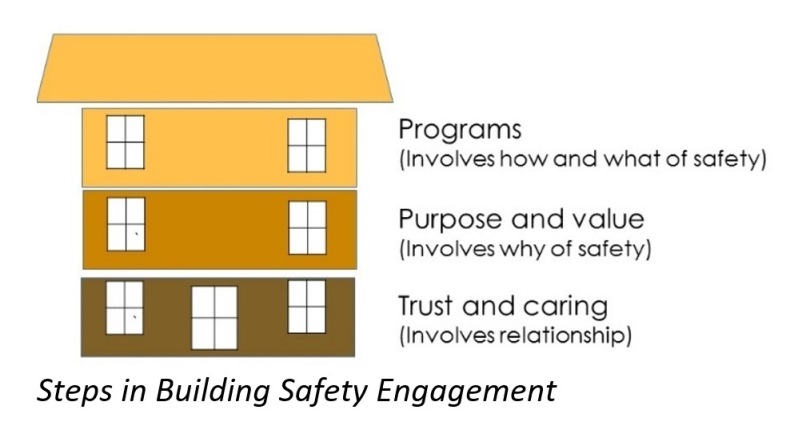
Steps in Building Safety Engagement
The second layer involves the purpose and value of embracing safety. When we think about safety, we tend to obsess over the “what” and “how”— as in, “This is what you need to do,” or “This is how you do this.” Yet we rarely focus on the “why”— as in, “Here’s why we’re doing it.” It is often difficult to go the extra mile if we don’t know the purpose and value of doing it in the first place. A powerful way to teach employees about that purpose and value is to spend a little less time telling how and a little more time showing why. This entails communicating a purpose, walking the talk, demonstrating that efforts make a difference, and appreciating people.
The third layer consists of the activities that foster engagement by inviting collaboration, encouraging involvement, and building team spirit. The stability of this third layer depends on the strength of the layers below. This explains why engagement programs often fail, even though they are meticulously planned and proven to work in other organizations. When you neglect the first two layers, and focus just on the third layer, the house of engagement might look tall and nice in the short term, but it will not stand the test of time.
How to build a positive relationship based on trust
We all know what a 3D movie lens is. It changes images that look blurry to the naked eye into three-dimensional ones. A trust lens is a metaphor that describe how we view the actions of others, based on the level of trust we have in them.
When I wear a lens of high trust towards you, I see your actions in a positive light. I believe that what you do or say can be trusted and that you have my best interests at heart. In turn, I share my ideas and thoughts freely and take more initiative at work.
Inversely, a lens of low trust makes me assume the worst. I wonder, “What are you up to?” I focus on protecting my interests first. It does not matter what your intention truly is; your action is filtered through my trust lens.
When the employees wear lenses of low trust towards their leaders, any engagement efforts are bound to fail. Employees see such efforts as manipulative or self-serving. They reciprocate by resisting and criticizing these initiatives. Before employees can trust your message, they must trust you as the messenger.
There is a tremendous amount of information on the Internet about trust in the workplace. All in all, building trust requires adherence to five standards:
• Behave with integrity (admit mistakes, keep promises)
• Be transparent (talk straight, do not sugarcoat bad news, do not withhold information)
• No second guessing (increase decision-making authority, trust what an employee has told you instead of double-checking with others)
• Be fair (distribute work fairly, apply the same rule to everyone)
• Be professional (make sound decisions consistently, produce quality work, do not throw tantrums)
If trust is lacking in the workplace, the leaders have probably missed one or more of the standards above. And they need to seriously think about how to regain the trust of their employees. When employees are wearing lenses of low trust, getting things done demands much more effort and time than it might if they were wearing lenses of high trust.
How to build a positive relationship based on caring
Below are the two most important ways to demonstrate caring:
Know the person behind the title. Gone are the days when people expect leaders to sit behind a closed office door and dictate from above. In the modern workplace, the best leaders get to know their employees on a personal level. Spend some time each day chatting with your employees. Ask them about their families, hobbies, or vacation plans. The more you know about a person, the more chances you will have to care about him or her.
Go the extra mile for them. In February of this year, there was a TV series on Channel 8 called “What Makes a Boss.” It recapped how entrepreneurs started their companies, and highlighted their relationships with their employees. There were a handful of touching scenes about bosses going above and beyond:
• A technician from China arrived in Singapore to work. Realizing that he did not understand English at all, the boss specially hired a tutor to teach him and a few others in the company. The company fully sponsored the training. The technician gradually picked up the language and has been with the company for seven years.
• An assistant marketing manager who had worked over 20 years in a company had the shock of her life. She was diagnosed with cancer. Having to take time off regularly for chemotherapy sessions, she soon used up her sick leave. In addition, her work was adversely affected. When she tendered her resignation, her boss was very understanding. She made arrangements so that the marketing manager could complete her treatment and continue working.
• As an employee of a video production company, one introverted young chap brought up to his boss that he intended to propose to his fiancée. His plan was simple. He would just buy a ring and propose at home. Nothing fancy. The boss convinced the young chap to do more, even volunteering to help. The boss even called up other colleagues to give him support. On the day of the proposal, some colleagues played the guitar, some played the piano, and others set up the scene. What was supposed to be an unromantic moment became the memory of a lifetime.
The employees mentioned above all expressed heartfelt gratitude to their bosses. No prizes for guessing whether these employees will go the extra mile at work. Quoting John Maxwell, “Nobody cares how much you know until they know how much you care!”
Before safety can come first, people must come first. It starts with building a trusting and caring relationship. And that relationship starts with you, the leader. If you want employees to care more about safety, you must care more about them. If you want people to trust your programs, you must be trustworthy. Building such a relationship takes time. But when you’ve got that foundation, it sets you up for success, not only in safety, but in all aspects of business.
References
• Coffman, C., and Gonzalez-Molina, G. Follow This Path: How the World’s Greatest Organizations Drive Growth by Unleashing Human Potential. New York: Warner Books, 2002.
• Covey, S. The 7 Habits of Highly Effective People. New York: Free Press, 1990.
• Harter, J. K. etc. Q12 Meta-Analysis. Omaha: The Gallup Organization, 2015.
• Krause, T. and Bell, K. 7 Insights into Safety Leadership. The Safety Leadership Institute, 2015.
• Macey, W.H. and Schneider, B. The Meaning of Employee Engagement. Industrial and Organizational Psychology, 1: 3–30, 2008.
• Marciano, Paul. Carrots and Sticks Don’t Work: Build a Culture of Employee Engagement with the Principles of RESPECT. New York: McGraw-Hill Education, 2010.
• Pink, D. Drive: The Surprising Truth About What Motivates Us. New York: Riverhead Books, 2011.
What does it Take To Be a Safety Leader?
“Is leadership important?” I asked a friend from the safety industry over lunch.
“Yes, of course!” His eyes lit up, and he leaned forward.
“Look at Man. United. They just change one manager, while the rest of the (soccer) squad remains the same, and they fall from heaven to earth. It is so disappointing!” (A few months after my friend made his comments, that manager was sacked for poor performance.)
I had been expectating some stories relevant to workplace safety. Nonetheless, my friend had answered my question. Leadership is important.
The same applies to workplace safety. In an insightful study done in 1998 in the United States, results from 550 sites that had implemented the behavior-based safety (BBS) process were evaluated to identify critical success factors. The conclusion was that “the most important factor in predicting success of safety improvement initiative was the quality of leadership they were given and the organizational culture that resulted.”
Whether in implementation of BBS or other safety initiatives, companies that achieve safety excellence have leaders who demonstrate certain behaviors, and as a result create a certain culture.
What does a great safety leader do? There are five practices that great safety leaders have in common.
1 Clarify values
Should safety be a priority or a value?
The chart below shows the differences between priorities and values:
Priorities | Values |
Things you have to do in a certain order | Personal standards that you set for yourself to live by |
Externally imposed—given by boss, customers or by circumstances | Internalized—they are your moral compass |
Tend to change depending on situations | Remain fairly constant over time |
Priorities changes according to circumstances. There will be a number of priorities vying for top position at certain key times. During normal times, a worker can treat safety as a number one priority. But when another competing priority comes along, such as an urgent need to compete work fast, the production priority can move into the top position momentarily in order to meet the deadline. So while safety is the top priority 99% of the time, the organization is still vulnerable to safety violations, due to the 1% period where short-cuts are taken.
To create a zero accident workplace, safety has to be a value. Values are fixed regardless of time and circumstances. They constitute the personal and organizational bottom line. They tell you when to say no and when to say yes. They set parameters for hundreds of decisions you make every day, consciously and subconsciously.
Embedding safety as a core value in the organization starts with leaders. The first step a leader must take along the path to becoming a great leader is inward. Leaders have to clarify their values and articulate them to their followers.
Clarifying values – Values cannot be imposed. Leaders have to explore their inner self and find their voice in safety. One good way is to first clarify their personal values, i.e., among a list of values, what are the top 3 or 5 values they consider the most important? After that, they would link these personal values to workplace safety. Many of the values, such as family, health, respect and trust, can be expressed in the context of safety. For example, if a leader values trust, he can relate to the fact that the staff are trusting the company to keep them from harm. Therefore, he will strive to maintain that trust by providing the necessary resources and efforts in workplace safety.
Articulating values – Have you heard leaders proclaiming that they are serious about safety, and sounding so compelling and motivating, while others sound fake, as if the words do not belong to them—as if the words are merely recited from a safety handbook? Leadership is a form of personal expression. To be a credible leader, you have to learn to express yourself in ways that are uniquely yours, not derived from someone else’s values or words.
2. Inspire a shared vision
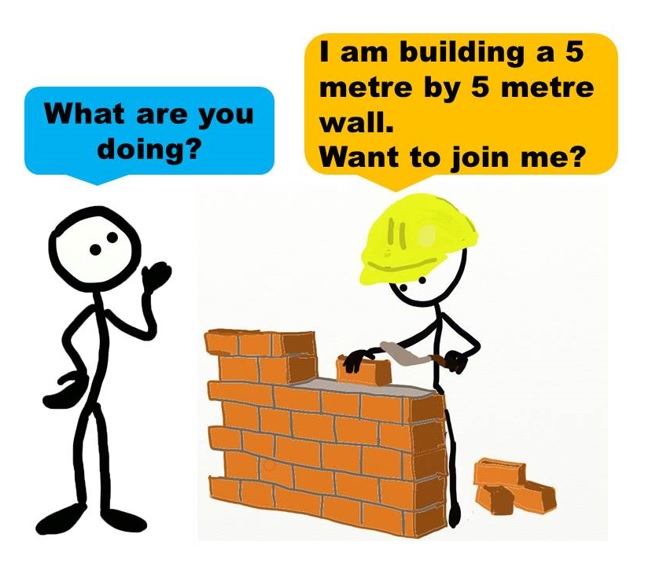
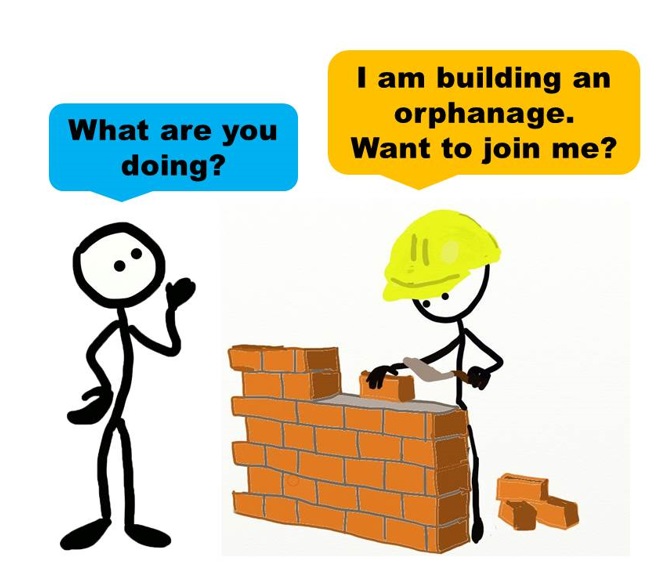
Who would you follow, in the pictures above?
Most of us will follow the person building an orphanage, because he conveys a meaningful cause. Deep within us, we have a desire to do something good and make a difference.
The person on the left describes a strategy, while the person on the right describes a vision. A vision serves two main purposes:
Vision motivates people in the right direction – The construction example above conveys an exciting vision of the future. It motivates people to take action in the right direction even if the initial stages are tiring and laborious. The vision becomes the energy behind every effort, because people commit to causes, not action plans. Introduction of a “working at height” campaign, implementing a behavioral-based safety process or expanding the EHS team are all action plans. They are the “how to,” not the “why.” A strategy can never align and inspire action the way a vision can.
Vision helps to coordinate the actions of different people – Saying the corporate equivalent of “we are going to build an orphanage” helps to coordinate the actions of different people in a remarkably fast and efficient way. With clarity of vision, managers and employees can figure out for themselves what to do without constantly checking with a boss or their peers. Without a clear vision, endless debate would arise about whether to delay a job for safety reasons, or whether to purchase a better quality but more expensive safety shoes.
The Latin root of the word “vision” means to see. Inspiring a shared vision starts with a clear mental image of what the desired future looks like. “Zero harm” is a worthy cause but a vague term on its own. Leaders need to breathe life into this vision. They need to explore the questions below with their staff.
• What will the staff do and say when the organization is at zero harm?
• What will visitors to the company do and say?
• What will management do and say?
When leaders are able to provide a vivid destination postcard to their followers, it allows everyone to visualize their role in creating a better future.
3. Model the way
Clarifying values and inspiring a shared vision is about talking the talk. Modeling the way is about walking the talk.
When deciding whether a leader is credible, people first listen to the words then they watch the actions.
• They listen to the promises of “we are committed to safety,” and then they wait to see if the investments follow.
• They hear the pledge to “stop work when unsafe,” and then they listen to updates from people who actually stop the work.
• They read the emails professing that “near-miss reporting is important to the company,” and take note of how long it takes for the near-miss to be rectified.
When the talk and walk are not aligned, the people will judge that leaders are not serious about safety or even that they are hypocrites.
There are a number of ways for leaders to model behavior. Below are three of them:
• How do you spend your time?
The single clearest indicator of what’s important to the leader is how they spend their time. One good question to ask participants in a safety leadership training is whether, when they open up their calendar, daily planner or meeting agenda, the safety activities show up inside. If yes, is the time allocated commensurate with their promises about safety? Further, is most of the time set aside for safety spent in meetings and sending emails, or walking the site and engaging people?
• Watch your language
The words a leader uses can have a powerful effect on how their followers see the world, and the leader should choose them carefully. One word to beware of is “but.”
“Do this by tomorrow but safely” is markedly different from “Do this safely but by tomorrow.” When someone tells you that “Safety is important, but…,” your heart will inevitably sink because you know that the brutal truth is coming. What lies before the “but” tends to be unconsciously ignored.
Communication also needs to be perceived in the right way. When a project director from HQ was inspecting a construction site, a technician reported to him about several hazards onsite. The project director asked if the project manager had been notified, and the technician replied no. The project director then retorted, “Why are you telling me this? The project manager is directly responsible for the site. Report to him first. Let me know if he does not follow up.” Word began to spread that the project director was not committed to safety. The objective message of the project director was indeed correct, that safety reporting should follow the chain of responsibilities. However, the way he communicated it was perceived by others as being indifferent to safety. Therefore, it is not only important to be saying the right thing, but to be perceived to be doing so.
• Watch your non-verbal language
Body language is an important part of communication. Seventy percent of what we communicate is through body language, not words. I recall how when a certain manager talked about the supply chain, his facial expression, hand gestures and the energy in his voice sent across the message that he was enthusiastic. Supply chain was an area he held dear. When he spoke about workplace safety programs at the end of the talk, his energy level notably dropped by half. He might not even have been aware of this, but the audience was receiving a clear message about his lack of passion for safety. Another manager started a meeting by announcing that “safety is our core value” but in a manner that suggested “let’s get this out of the way and carry on with the important stuff.”
There are many techniques for delivering the right body language, such as making eye contact, speaking with energy and using hand gestures. But these techniques are superficial, compared to what is within the leader. When a leader is clear in his values and vision for safety, the right body language will follow. Values and vision are like the hub of a wheel. When the hub is sound and greased, the wheel will rotate easily.
The three practices above are all about the leader himself. These practices lay the foundation for safety engagement and commitment, because if people don’t believe in the messenger, they won’t believe in the message. Sometimes, when safety initiatives fail to take off, it is not due to the quality of the initiative but the lack of credibility and inspiration of the leader who is selling it.
4. Build trusting relationships
Leadership is a relationship, not a position. I have seen a technician working in a chemical plant, who was able to mobilize his eight colleagues to stay back after work voluntarily to do housekeeping. I have also seen a department manager whose three staff are often late or absent for the safety committee meeting. Before the start of the meeting, that manager usually has to take out his phone and call his staff one by one, gently requesting that they turn up for the meeting. Despite his position, he is not able to mobilize his followers.
Good leaders make the effort to engage their followers at a personal level. I remember a project director in the construction industry who managed a team of 30 full-time staff and contractors. He was a plump guy in his late forties, whose room was at the very end of the office. Every Monday morning, he would walk to the pantry and fill up his mug. Then he would make a point of visiting various cubicles and saying “hi” to his team. He would ask about their weekend, appreciate them for a job well done or listen to their concerns. Sometimes he would make fun of himself, and at other times he would groan at the workload he had to clear up. His team members adored him, and worked hard for him. For staff who were scheduled to visit the construction site, he would ask them about the hazards at the plant. If there were any safety issues, he would put on his helmet immediately and follow his staff to the site. At the end, the project would be completed without any accidents, with few refits and right on schedule.
Relationship cannot be mandated. It has to be earned. It requires making yourself available to the people, listening to them and helping them out. Leaders touch a heart before they ask for a hand. This is true whether in workplace safety or other areas.
“But building relationship takes too long,” one workshop participant remarked to me. “It is easier and more effective to establish strict rules and enforce them. Sometimes you have to use a stick to force people to change their behavior first, and the mind-set change will follow.” My reply in short is that both approaches are essential. A stick approach builds compliance, while the relationship approach builds commitment.
Figure of Commitment vs Compliance
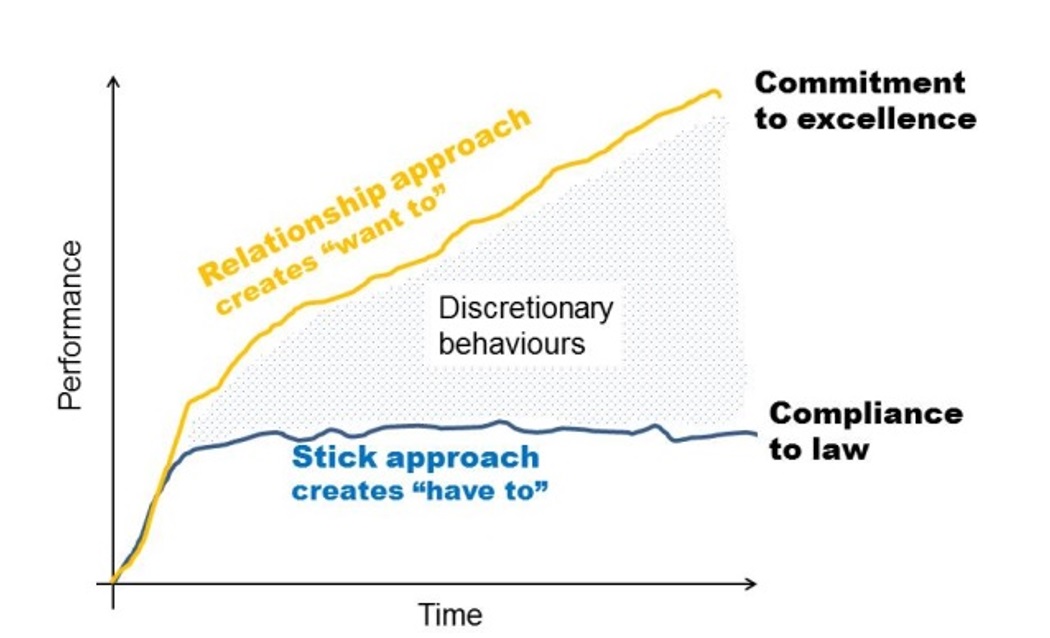
If the staff of an organization are not meeting the legal and other requirements, the stick approach has to be used. Strict rules and disciplinary actions are swift and effective to get to the line of compliance. However, if the vision of the organization is to get to zero, what is needed goes beyond meeting only the legal requirements.
In an organization that is excellent in safety, the staff actively report near-misses, provide genuine feedback during safety meetings, and take care of the safety of their co-workers. These discretionary behaviors are also known as organizational citizenship behavior. They are the result of a high commitment level of the staff toward safety, which is in turn established upon a caring and trusting relationship with their colleagues and the management. This takes time and hard work.
When the stick approach is used (usually in conjunction with KPIs) to drive such organizational citizenship behaviors, it will probably result in meeting only the quantity objectives and not the quality objectives.
5. Challenge the process
Leadership is about creating change, while management is about maintaining consistency. To create change requires challenging the status quo. Great safety leaders are prepared to search for opportunities to grow and improve. Below are examples of two common problems with safety efforts that could be challenged:
• Management or safety department makes all the decisions in safety
Also known as the “I know best” approach, initiatives and programs are finalized and implemented from the management level. Some safety meetings have become just a platform for dissemination of new programs. In other cases feedback from employees is only sought as a courtesy when the implementation plan has been finalized. When employees see such initiatives as belonging to “them” instead of “us,” ownership and buy-in are weak. Quoting Stephen Covey, “Without involvement, there is no commitment. Mark it down, asterisk it, circle it, underline it. No involvement, no commitment.”
With that said, sometimes when management starts seeking feedback, employees choose to remain quiet and adopt a hands-off approach. This could happen when the leaders are not engaged in the previous four practices. When the leaders are not seen as inspiring and credible in safety, and have a poor working relationship with the staff, the staff will reciprocate through silence and indifference. Voicing one’s feedback is a type of discretionary behavior built upon trusting relationships.
• Safety awards are based on accident rates
A typical award criterion is based on team performance. By working for a year or X number of man-hours without any accidents, the team gets the award. Every company tracks safety injury statistics, and it is easy to base the awards on these data. While such awards promote safety awareness, they do little to motivate the right behavior in safety. With today’s low accident rate, employees can take short-cuts to complete work faster and more comfortably, and yet not have an injury. Even when employees suffer from a minor injury, they can choose not to report it so that the accident sheet remains clean.
One alternative is to base safety awards primarily on behaviors, such as conducting observations, leading safety meetings, and other activities that directly and indirectly contribute to the safety of co-workers. This was the view of Terry McSween, in his book titled The Values-Based Safety Process. He suggested two rules of thumb which I find useful:
• Rule of thumb #1: Provide safety awards for safe behavior on the job and for activities related to maintaining the safety process.
• Rule of thumb #2: Keep safety awards small. Your awards should be significant enough to support compliance but not significant enough to generate false reporting of data.
In summary, safety leadership is about building credibility through clarifying your values and modeling the way, about inspiring a shared vision, about relationships, and about challenging the status quo. All these practices are about what you do, and not about your genes, your title or position.
Do you have what it takes to be a great safety leader?
References
• Hidley JH “Critical Success Factor for Behavior-Based safety” Professional Safety 43:30, 1998
• Kotter John, Leading Change, Harvard Business Review Press, 2012
• Kouzes James & Posner Barry, The Leadership Challenge 5th Edition, Jossey-Bass, 2012
• McSween Terry, The Values-Based Safety Process, John Wiley & Sons, Inc, 2003
• Maxwell John, The 21 Irrefutable Laws of Leadership: Follow Them and People Will Follow You, Thomas Nelson, 2007
Ownership in Safety – The Who, Why, and How
Last year, during a family vacation in Langkawi, I rented a car. It was a red Proton Saga, not new but clean. At the end of the trip, I returned the car in dirty condition – the result of driving through muddy puddles. The staffer at the rental company walked around the car to check for damage. There was none. He accepted the car with a reluctant smile.
With a tinge of guilt, I asked my wife, “Do you think anyone will wash the car before returning it?”
“Why would anyone want to do that? They don’t own the car,” she replied.
Fast forward one month later: I met up with a friend, who is a safety practitioner. He lamented the lack of proactiveness among his production staff. He has to persuade, argue with, and sometimes even threaten them to get safety tasks moving. “They see safety as my work. Anything I ask them to do is additional work.”
At that moment, I was hit with a sudden realization – ownership matters. Just as driving a rental car reduced my desire to take care of it, perceiving workplace safety as the responsibility of the safety department reduced the production staff’s desire to be proactive.
If ownership is so crucial, who should own safety in an organization? There are three possibilities:
• Everyone
• Safety department
• Production department (or line function)
Should everyone own safety?
Since safety is everyone’s responsibility, everyone should own safety. This is obvious, right?
I beg to disagree. Responsibility and ownership are different. When I rented the Proton Saga, I drove carefully, topped up the petrol, and removed my litter from the car every day. These are my responsibilities. If the car were to go into the shop for maintenance, the workshop mechanic is expected to service the car professionally. It is his responsibility. But neither the mechanic nor I own the car. We do what we do because the owner – the car rental company – expects us to do our part. The car rental company has overall responsibility for the car.
Similarly, some person or function must be in charge of leading, directing, and implementing safety. This person or function must bear the overall responsibility for safety. The issue with everyone owning safety is that it usually ends up neglected. Too many cooks spoil the broth.
Should the safety department own safety?
In many organizations, the safety department is the face of safety. As subject matter experts, they chart out the strategies, develop the procedures, and communicate requirements to the operation departments. To ensure that the requirements are followed, the safety professionals also direct the implementation of new initiatives, lead safety meetings and enforce the rules. In such organizations, the production department tends to let the safety department manage safety, while they look after production.
This siloing of safety and production ownership has the unintended consequence of pitting safety against production. In the daily life of an organization, the employees have to juggle dozens of activities, often with limited resources. To select priorities, the employees take cues from their immediate supervisors and managers. Managers who focus on increasing production output and lowering operating costs, who praise employees for meeting production targets and reprimand them for missing them, send the message that “production is king.” The priorities of production managers eventually become the priorities of supervisors and then of front-line employees.
When the safety department comes forward with a list of additional requirements, the production staff sees safety as a hindrance to their production goals. To them, safety is like a rental car. Since the car is not theirs, why should they shower it with extra care? The tendency is to go through the motions and do the minimum necessary to keep the rental car company (safety department) at bay so that they can focus on getting to the destination (meeting production goals). The destination is where their bonuses and promotions lie. Furthermore, if there are issues with the car, the rental car company (safety department) will be at the forefront of dealing with them. As a staff function, the safety department lacks control and authority over the production staff. When the sole focus of the production department is to meet production targets, the safety department faces an uphill battle to advance the safety agenda.
To excel, the safety department should not own safety. The production department, also known as the line function, should. In fact, safety experts and authors have stated this numerous times.
Should the production department (or line function) own safety?
The line function owning safety is not a new concept. Over 200 years ago, Dupont used this concept while operating black powder mills in Delaware, USA. Members of the Dupont family and other supervisors were personally accountable for the safe operation of the mills. They were even required to live next to the mills. The following was posted on the doorway to the mills:
“Safety is a line management responsibility…..No employee may enter a new or rebuilt mill until a member of top management has personally operated it. E. I. Dupont.”
Two hundred years later, line function ownership of safety has is responsible for Dupont being consistently recognized as one of the safest companies in the world.
There are several reasons why the line function owning safety works:
1 Ultimate authority over line staff – The line manager directs, supervises, and appraises the line staff for the work. He has direct control over which tasks should be done and how they should be done. When the line manager takes ownership of safety, through his formal authority and personal influence, his staff also takes ownership of safety.
2 Effective management of risk – The people who manage, supervise, or perform the work are in the best position to control the risk. When safety is integrated into every stage of the work process, safety risks can be managed promptly and effectively throughout. As Harold Dodge said many years ago, “You cannot inspect quality into a product.” Similarly, the safety department is not able to monitor safety to a state of excellence.
3 Commitment to safety – Ownership means having the autonomy to make key decisions, as well as being accountable for performance. This in turn creates commitment to safety. The line staff will make decisions thoughtfully, responsibly, and with greater care. They will also be more driven and have more initiative, rather than going through the motions and fulfilling the minimum requirements.
4 Integration of safety into production – When the line function owns safety, the line between production and safety disappears. No more production or No more production and safety. Instead, simply safe production. Safety is not seen as an additional requirement, but rather an integral part of the production process.
What ownership means for the line function
The line function owning safety means that the line management (and senior management) has the ultimate responsibility for safety. These responsibilities include:
• Directing and performing work in a safe manner
• Enforcing all rules and procedures
• Investigating all accidents and implementing correction measures
• Holding regular safety briefings/meetings to review safety performance
• Ensuring that employees receive adequate training
• Carrying out regular inspections of the workplace
Owning safety also means being held accountable for performance. Being accountable and being responsible are different. If you are responsible, you perform a task. If you are accountable, you answer for it. All too often, employees are given responsibility for safety, but are not held accountable should they fail at the task.
However, this does not mean that the line management resolves every issue alone. They can’t, even if they want to. They may not be familiar with the latest legal safety requirements. They may not be able to train the workforce, or conduct effective investigations. This is where the safety department comes in.
Using the car analogy above, the safety professionals are like car maintenance experts. They advise and support the car owners (line management) to keep the car (safety) in tip-top shape. In this advisory role, the safety department stands behind the line management, and watches out for them. Consequently, the line management is seen as the face of “safe production”.
The responsibilities of the safety department include:
• Providing advice to senior and line management
• Creating and monitoring the safety management system
• Providing oversight and prompt safety activities
• Conducting safety training and drills
• Communicating developments in legal requirements and best practices
• Recording and analyzing information about accidents and illnesses
Line function owning safety – making it happen
How do you make the line function feel responsible for safety? It is not easy. Organization structures have become leaner over the years, with staffs doing more tasks with fewer resources. The plates of the production department are full. There seems to be no room to add on safety ownership. One common belief is that the production department owning safety will compromise productivity.
Such a belief sees safety and production as a zero-sum game, which is not the case. It is more like exercising. The more you exercise (invest time and effort in safety), the leaner you become (fewer accidents and down-time). Eventually new sources of vigor emerge (better morale and increased teamwork), and you become more productive!
Of course, telling the line function that they should own safety, and wishing it will happen, does not make it happen. There are three key aspects that determine whether the line function owns safety:
1 Personal consequences – People focus on what they get measured and rewarded for. Clearly defined accountabilities, which are tied to financial consequences, remove the ambiguity of the expectations. If “safe production” is the goal, then the weighting of “safety” in the performance appraisal has to be high enough that it reinforces superb safety performance and reduces poor safety performance.
2 Top management commitment – People observe what their superiors focus on. Everything rises and falls on leadership. When safety becomes a “hot button” for top management, everyone in the organization eventually knows it and follows the lead.
3 Perceived control – People are motivated to work on things that they have control over. Providing adequate resources (time, people, budget, training, etc.) and empowering the line function to make key safety decisions makes it easier for them to own safety.
Every individual plays a role in safety, but ownership lies with the line management (and senior management). The role of the safety department is advisory. Who owns safety in your organization? The answer may explain the proactiveness and commitment (or lack thereof) among the line staff.
References
- Frank Lees, Lees’ Loss Prevention in the Process Industries: Hazard Identification, Assessment and Control (3 Volumes), Butterworth-Heinemann; 4 edition, August 17, 2012
- Michael Karmis, Mine Health and Safety Management, Society for Mining, Metallurgy, and Exploration, November 1, 2001
- Terry Mathis and Shawn Galloway, Steps to Safety Culture Excellence, Wiley, 1 edition, February 11, 2013.
Lorem ipsum dolor sit amet, consectetur adipiscing elit. Ut elit tellus, luctus nec ullamcorper mattis, pulvinar dapibus leo.
Three Practices of Transformational Safety Leader
What’s the single most important factor that will propel your safety performance to greater heights?
Leadership!
The answer hasn’t change over the years. In 1998, John Hidley, a researcher studied two clusters of companies1—one cluster was extremely successful in implementing BBS (Behavioural-based safety) while the other failed completely.
He wanted to isolate the defining factor between the two clusters. His conclusion: The most important factor in predicting success of safety improvement initiative was the quality of leadership they were given and the organizational culture that resulted. In successful companies, their leaders demonstrated certain desirable behaviours, and as a result created a positive culture.
In 2020, ERM Consulting surveyed close to 300 senior EHS leaders2. When asked on the “most effective means to drive EHS”, the top three answers were:
- Leadership commitment and engagement – 63%
- ‘One Team’ culture, everyone involved, empowered and collaborating – 22%
- Leadership connection to the frontline – 17%
EHS professionals seem uncannily consistent in the way most of them believe that senior and middle managers hold the key to unlock safety excellence.
Leadership isn’t an easy topic. There are many models and theories out there espousing on what makes a great leader. One theory that stood out is Transformational Leadership. It has appeared in numerous safety literatures, and correlates to exemplary leaders such as Paul O’Neill and Cynthia Carroll. In a nut shell, transformational leaders build relationship with their followers, demonstrate clear values, and empower their workforce. They focus on moving their follower’s hearts, instead of targeting their hands and feet through orders and control. Transformational leaders demonstrate four practices3:
- Individualised Consideration (i.e., care and trust)
- Idealised Influence (i.e., role model)
- Inspirational Motivation (i.e., values and vision)
- Intellectual Stimulation (i.e., involvement and empowerment)
This article will cover the first three practices.
Individualised Consideration (i.e., care and trust)
Management often talks about the importance of employees “doing the right thing when nobody is looking”, “taking ownership” or “speaking up about safety”. Yet, despite the best efforts to train and brief employees, they aren’t engaged. They either take short-cuts in the absence of supervision or put in minimal efforts to avoid punishment.
What’s missing here?
In literatures, the proactive behaviours stated above are known as Safety Citizenship Behaviours, which refers to safety behaviours performed by employees that go above and beyond their normal work role. Such behaviours were found to correlate strongly with Perceived Organizational Support (i.e., “Does my company cares about me?”) and Leader-Member Exchange (i.e., “What’s my relationship with my direct supervisors?”). This is perhaps unsurprising. If you feel that your company and manager cares about you, you will reciprocate. You will go the extra mile, and you are in the game.
Some years back, I was part of a team starting up a chemical plant. The project director was a tall and lanky German in his late forties. I had the privilege of observing the way in which he engaged his employees. Every morning, he would walk from his room at one end of the office to the pantry at the other end of the office, to top up his mug. It would take him ten minutes, even though the distance should have taken less than half a minute. He would stop at the desks of his employees and talk to them, sometimes about work, but more often simply a casual chit-chat. He would ask them about their weekends, or discuss how their families were doing, or share some laughs about politics or soccer. It was a deliberate effort: I noticed that in a week, he managed to talk to almost every one of his twenty staff. His staff adored him. Some of the feedback I heard were:
• “He cares about me as a person.”
• “He treats everyone fairly and with due respect.”
• “He has my back.”
• “He supports me professionally and personally.”
All of them were energetic and helpful. The project was delivered within budget, on time, and without any safety accident. The project director taught me one thing: Before safety can come first, people must come first. If a leader doesn’t care about his people, why would they care about him and his goals?
Idealised Influence (i.e., role model)
How should a leader influence his followers to value safety? Or, to put it another way: how do followers learnt what’s important?
Through advances in functional magnetic resonance imaging (fMRI), neuroscientists are able to uncover how our brain responds to external stimuli. They found that our brain is mainly an image processor—a large part of it is devoted to processing visual images; only a small part is devoted to verbal and written words. Not only do we learn from images faster, we remember them longer. That’s why when writing stories, authors advocate the technique of “show, don’t tell.” They strive to paint an image for their readers, rather than relying on generic words. Similarly, the adage “actions speak louder than words” reminds us to do more and talk less.
In fact, when it comes to changing the safety behaviours of employees, 75% of the respondents (in the ERM survey) identified leader visibility on the frontline as the most effective means. Spending time on the shopfloor shows that you are interested in the day-to-day challenges of the employees and are prepared listen to them. Not only do you demonstrate your value, you learnt about their concerns and challenges. Business literatures termed this Management by Walking Around (MBWA), which means visiting employees informally to check in with them. Lean Production philosophy termed this Gemba Walk, which means taking the time to watch how a process is done and talking with those who do the job.
Yet, leaders aren’t spending enough time on the frontline! Only one-third of the respondents from the survey expressed that their senior and middle managers were spending sufficient time in the field on safety. A similar percentage felt that their leaders were effective in “hazard recognition and engaging effectively as coaches”. This means that managers aren’t only spending insufficient time on the field; when they decided to walk the ground, they aren’t able to influence employees positively. A priority and skill gaps exist in this area.
Inspirational Motivation (i.e., values and vision)
If you examine how safety programs are communicated, you find the focus is on the ‘what’ and ‘how’; there’s little to no bandwidth on the ‘why’.
Take for example the messages below:
• “Due to the recent spurt of accidents, we are going to step up our inspection regime (the what). Everyone here has been grouped into teams. Here’s your schedule, and here’s the new inspection form (the how).
• “Everyone, please submit two suggestion forms by the end of the month (the what). You can obtain the template from the shared drive (the how). I look forward to your participation.”
When the ‘why’ behind an initiative is missing, employees will simply add in their own, and it may not be the ‘why’ you have in mind. Some of the remarks you might have heard are:
• “We are very busy already. Why are you pushing all this stuff on us?”
• “They just want to make life difficult for us.”
• “Maybe the safety department is doing this to earn points with the boss.”
To understand the importance of a purpose, let’s take a look at the study done by Ellen Langer, a Harvard psychologist, in the 1970s4. The test subjects are college students using a photocopier. At that time, personal computers and desktop printers hadn’t been invented yet, so to duplicate documents, the only way was to photocopy. As a result, photocopiers inside campus often attracted long queues.
Langer’s crew would spot someone waiting for his or her turn at the photocopier and walk over, with the intention of cutting into the person’s line. The crew would look at the innocent test subject and ask one of three questions:
• Version 1 (no reason) – “Excuse me, I have 5 pages. May I use the Xerox machine?”
• Version 2 (valid reason) – “Excuse me, I have 5 pages. May I use the Xerox machine, because I’m in a rush?”
• Version 3 (fake reason) – “Excuse me, I have 5 pages. May I use the Xerox machine, because I have to make copies?”
You will notice version 3 gives a nonsensical reason—of course you have to make copies; why else would you want to use it in the first place?
The crew approached 60 users, and the results were:
• Version 1 – 60% agreed with the request
• Version 2 – 93%
• Version 3 – 94%
It makes sense that version 1 yielded the worst performance—asking for assistance without justification makes you look self-centred. But, surprisingly, giving a senseless reason did as well as a real reason. Langer concluded that using the word ‘because’ boosts the chances of agreement to a small request. We want meaning in what we do. Hearing a reason, even a fake one, appeals to us.
Do note that a fake reason only works for a small flavour. In another version of the experiment, Langer’s crew changed the experimental condition to 20 pages (instead of 5). In this version, only a valid reason increased the chances of success. When the test subjects had to make a big sacrifice, giving a fake reason had the same effect as not giving any. Hence, if you need substantial efforts from employees, you’ve got to state a compelling purpose. People want to make a difference. Give them reasons to buy-in to your initiatives. ‘How’ and ‘what’ move hands and feet, but ‘why’ move hearts.
Conclusion
Traditionally, senior managers play a back-seat role in safety, leaving to their safety managers to spear-head it. Such an arrangement only gets you so far—employees tend to see ‘safety’ as a chore imposed by the safety department rather than a core value of the organization. They follow rules because they ‘have-to’, rather than ‘want-to’.
To foster a culture of safety, managers need to lead in safety. This means changing the approach from:
• Relying on position to building relationship
• Managing by exception to leading by example
• Focussing on ‘what’ and ‘how’ to sharing the ‘why’
References
- Hidley J.H., “Critical Success Factor for Behavior-Based safety”. Professional Safety 43:30., 1998
- ERM, ERM Global Health and Safety Survey, https://www.erm.com/insights/2020-global-health-and-safety-survey-report, Accessed 12 May 2020.
- Bass B., Avolio B. Improving Organisational Effectiveness Through Transformational Leadership.Sage Publications., 1994.
- Langer, E. et al. “The mindlessness of Ostensibly Thoughtful Action: The Role of ‘Placebic’ Information in Interpersonal Interaction”. Journal of Personality and Social Psychology6:635–642., 1978.
How to Choose the Right Safety Metrics to Drive Performance
Metrics are essential to workplace safety management. Traditionally, organizations measure accident rates (lagging indicators) because of legal and corporate requirements. Increasingly, more organizations are measuring leading indicators to obtain a more complete picture of safety performance. The right metrics drive the strategy of the organization and provide focus, while the wrong ones can lead to poor decision-making and may even create confusion. This article will explain how to choose the right metrics and, subsequently, how to use them to drive safety performance.
The Problems of Using Lagging Indicators
Almost all companies measure the number of accidents or the accident rates. These measurements are also known as lagging indicators, because they indicate facts about past events. The problems of tracking only lagging indicators have been well-known. Such indicators tell you how many accidents have happened and how serious they are, but they do not encourage future prevention. For example, when managers see a low accident rate, they may become complacent and put safety on the bottom of their to-do list. In fact, numerous risks might exist in the workplace which could cause accidents in the future. Furthermore, a survey conducted by Mercer ORC revealed that the more pressure you exert on the lagging indicators, the less accurate they become, due to under-reporting and creative interpretation of what can be called an “accident.”
The Problem of Using Leading Indicators
Because of the limitations of lagging indicators, more organizations are using leading indicators to measure their performance. Examples of leading indicators are percentages of staff being trained, number of near misses reported in a year, and number of audit findings closed. Leading indicators are proactive in nature. They precede accidents and are actionable, which means that they can aid prevention.
Many people believe that when the leading indicators improve for an organization, the accident rate will drop. This belief is only true if the right activities are implemented. “Right” means that the activities chosen add value to safety performance and affect the accident rate downstream. There are many leading indicators you can track, but not all of them can be shown to have moved the needle in accident rate. For example, at one manufacturing site, frontline employees understand safety requirements but behave unsafely because their supervisors prioritize production over safety and implicitly encourage employees to disregard safety. Providing refresher training for employees will not impact safety performance. For the case above, although “percentage of staff being trained” is a leading indicator, improving it does not lead to lower accidents. What is right for one company at a particular stage of its development may not be right for another company.
In year 2013, the Campbell institute conducted a survey about leading indicators. About two-thirds of survey respondents said that leading indicators are either highly important or significant in their communications with company executives. During such conversations, the most commonly asked question is “How are leading indicators connected to actual EHS performance on lagging indicators?”
Therefore, the challenge in using leading indicators lies not only with choosing the right ones, but also with demonstrating their impacts on lagging indicators.
Luminous Indicators
Fortunately, certain indicators can link the leading indicators to the lagging ones. Think of it the way you might think about building a healthy lifestyle. Your goal is to be free of illness, which is the lagging indicator. The frequency of exercise and the amount of ‘green’ food in the diet are some of the leading indicators. To know whether these factors are effective, a person enrolls in a body checkup. His blood pressure, heart rate and cholesterol level, to name a few elements, provide insights on whether he is on the right track. For example, if the current level of cholesterol is high, the person’s diet may not be healthy enough, and he would need to make an adjustment. These body measurements provide clarity on the helpfulness of existing routines, as well as information about which routines might need to be adjusted.
By definition, these body measurements are leading indicators. Yet they are special, in that they shed light on the effectiveness of other leading indicators and predict with good accuracy the lagging indicators. In other words, such indicators align the leading indicators to the lagging ones. For ease of reference, these indicators are separately termed luminous indicators.
Figure 1: Relationships between Indicators
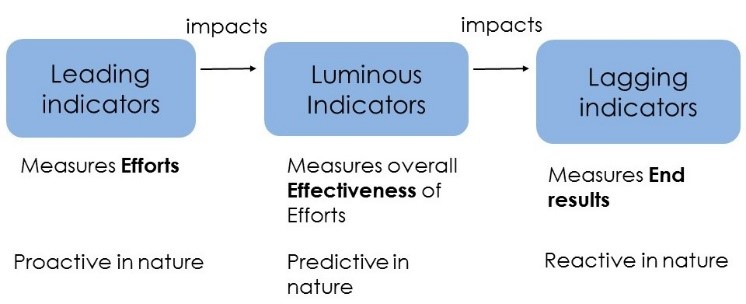
Unlike body checks, which can have several dozen luminous indicators, for workplace safety, there are only two key types: the number/percentage of unsafe conditions and the number/percentage of unsafe acts at the shop floor. The measurements are not new. However, when they are put into perspective with leading and lagging indicators, they illuminate the safety landscape of an organization.
These indicators predict the risk of accidents, because accidents are directly caused by either unsafe conditions or unsafe acts. For the accident rates to drop, the number of unsafe conditions and acts at the shop floor must first decrease.
These indicators also measure the overall effectiveness of the safety action plan (also known as the strategic plan or safety roadmap). For any action plan to be considered effective, it must improve workplace conditions or employees’ behaviour, one way or another. If it doesn’t do either of these things, it is not generating a return on its investment.
Setting Luminous Indicators for Unsafe Acts
Unsafe acts are usually more difficult to correct than unsafe conditions. While you can fix a broken railing easily, you cannot fix a worker’s behavior with the same ease. Human beings are complex creatures, influenced by a wide variety of factors at the workplace. Unsafe acts contribute to more than 80% of the accidents. Without reducing unsafe acts, achieving zero accident becomes impossible.
You begin measuring the luminous indicator for unsafe acts by defining a list of safety behaviours essential to safety improvement. In your workplace, what behaviours when carried out by all the frontline employees, would make the workplace safer than it is now?
If you pinpoint such behaviours, put them together in a checklist, and then observe the frontline employees at work, you can quantify the behaviour as “percentage safe behavior.” The observations can be based on work areas, timing, or types of work to obtain further insights. Such observations can exist by themselves, simply for measurement purposes, or they can be one component of a larger behavior-based safety process. When this indicator improves, it means that the risk exposure of the frontline employees has been reduced, and fewer accidents would be likely to occur.
Leading, luminous, and lagging indicators each provide a partial picture of safety performance. When used in conjunction, they clarify the picture of workplace safety and facilitate decision-making (Refer to Figure 2).
Figure 2: Using Measurement to Facilitate Decision-making
When Leading Indicators Are Unsatisfactory
When implementing your action plan, leading indicators allow you to measure the extent of completion of the activities. When leading indicators are not achieved, it is usually due to inadequate efforts from stakeholders. The stakeholders may have other priorities, may not see the value of these activities, or may simply be overstretched. In such cases, management support is required to push the agenda through.
Besides quantitative measurement, it is also important to measure the quality of a particular activity. In giving training, for example, you not only want the employees to participate in the training, but you want them to be able to recall the key information after attending it. A corresponding leading indicator would be “the percentage of participants who are able to recall the key points.” If your quality-based leading indicators reveal that your activities are not working well, make adjustments! For example, if your training does not build the desired skills and knowledge in frontline employees, you need to adjust the content or mode of delivery.
When Luminous Indicators Are Unsatisfactory
On the other hand, luminous indicators measure the overall effectiveness of the action plan. For example, when frontline employees are behaving unsafely despite having attended training and having acquired the required knowledge and skills, the leading indicators relating to training will be high but the luminous indicators will be low. This means that the action plan does not have the right components necessary to reduce unsafe acts or conditions. New activities would need to be introduced while certain existing ones would need to be scrapped. Doing more of the same thing would not work in such an instance.
The challenge lies in knowing what types of adjustments need to be made at the action-plan level.
Surprisingly, the most powerful insights on adjustment of action plans do not come from outside the organization. Nor do they come from the safety department or top management. They come from the staff working on the shop floor. What a manager thinks is the reason for an unsafe act may not be the reason cited by the staff members themselves. The frontline employees are the ones who carry out the work. Only they can provide the real reasons for their own behaviour. The key is to capture these reasons systematically through honest and open dialogue with the frontline employees. Dialogue means more than giving advice (e.g. “Not wearing eye protection is unsafe, please wear one in future”). It is a two-way process whose ultimate intent is to understand the unsafe acts, and remove their causes.
While unsafe acts directly cause accidents, they are never the root causes. There are reasons for the unsafe acts. Maybe a procedure is not feasible, maybe frontline employees do not see the need for it, or maybe the employees lack suitable tools. If you don’t intervene and talk to the employees, you will miss the chance to address underlying reasons.
The underlying reasons for unsafe acts, also known as inducing factors, fall into four major categories:
- Perceptions (person-related), e.g., “In my experience, this is OK.”
- Mental lapses (person-related), e.g., “I have forgotten…”
- Abilities (System-related), e.g., “I know a spanner cannot be used for hammering nails, but we do not have a single hammer in the store.”
- Social environment (Culture-related), e.g., “Nobody cares about safety here.”
While some inducing factors can be addressed directly by observers (e.g., giving a gentle reminder when a frontline employee forgets to put on his safety glasses), other inducing factors require the attention of the management (e.g., when many frontline employees give feedback indicating that “Nobody cares about safety here”).
Analysing these inducing factors can provide insights which enable management to tailor the action plan to fit the organization. (Refer to Table 2). The right action plan equates the best route to safety success. Working hard on achieving the leading indicators does not necessarily move you closer to zero accident. You have to choose the right route and then work hard.
Table 1: Activities and leading indicators relating to unsafe acts
Inducing factors | Possible activities for the action plan | Leading indicators | Luminous indicators |
Perception- related | · Communicate safety risks and precautions · Collate relevant videos and case studies | · Number of briefings conducted · % completion of action items · Number of frontline employees with ‘perception’ issues based on behaviour observation | · % safe behaviours · % safe behaviours based on o Work area o Timing o Job tasks |
Mental lapses | · Set-up signages and reminders at key locations · Briefing on safety requirements · Memos on notice board | · % completion of action items · Number of frontline employees with ‘mental lapse’ issues based on behaviour observation | |
Abilities (System-related) | · Provide required training · Completion of action items relating to equipment purchase or revision of procedures | · % of people attending training · % of people able to recall the key points · % completion of action items · Perception survey of frontline employees about new procedures, equipment, training · Number of frontline employees with ‘abilities’ issues based on behaviour observation | |
Social Environment (Culture-related) | · Involvement of management team in communication and inspection · Attend leadership workshop · Redefining of manager and supervisor roles in safety · Setting up accountability system in safety · Number of behaviour observations per manager | · Number of items completed by managers · Perception survey of safety leadership · % of action items completed · Perception survey of safety climate · Number of frontline employees with ‘social environment’ issues based on behaviour observation |
When Lagging Indicators Are Unsatisfactory
When an action plan is appropriately developed and effectively implemented, the leading and luminous indicators should improve, and the accident rate should be reduced. When the luminous indicators improve but lagging indicators remain high, the luminous indicators have probably not been measured accurately. Two reasons may have caused this inaccuracy. One, the scope of inspection or observation may not be comprehensive enough; key unsafe acts or conditions have not been included inside the observation or inspection list. Two, the quality of observation or inspection may be low; observers are accepting unsafe acts or condition as normal. As a result, the luminous indicators do not reflect the actual risks on the shop floor. Such an instance requires a recalibration of the ways in which the luminous indicators are being measured.
Conclusion
Using a metrics-driven approach paints a clear picture of performance and makes a complicated safety world less complicated. Were you to use such an approach, when you achieve zero accident, not only would you be able to explain how it has been achieved, you would also know how to duplicate the results year after year. When things don’t work out, you then know exactly what needs to be done and can focus finite resources on the activities that really matter.
To quote Epstein & Birchard (author of “Counting What Counts”), “Measures have great power, almost like genetic code, to shape action and performance…Change the measures, and you change the organism.”
References
- Campbell Institute. Transforming EHS Performance Measurement through Leading Indicators. Presented at NSC Congress & Expo, 2013.
- B. and M.J. Epstein. Counting What Counts: Turning Corporate Accountability to Competitive Advantage. New York: Basic Books, 2000.
- Galloway, S.M. and T. L. Mathis. Steps to Safety Culture Excellence. New York: Wiley, 2013.
- Spitzer, D. R. Transforming Performance Measurement: Rethinking the Way We Measure and Drive Organizational Success. New York: Amacom, 2007.
.